What Happens If Tire Pressure Is Too High On Your Car
Tire pressure is too high when your tires carry more air than the manufacturer recommends. Overinflated tires reduce traction, cause uneven wear, and increase the risk of a blowout. Understanding the signs and fixes keeps you safe and saves money on replacements.
Have you ever checked your tire pressure and found it was higher than it should be? Maybe you topped off the air on a hot day, or someone at the gas station overfilled them. Either way, tire pressure is too high more often than most drivers realize. And the consequences can be more serious than a rough ride.
When your tires are overinflated, they don’t perform the way they were designed to. Grip drops. Wear becomes uneven. And in worst-case scenarios, a tire can fail while you’re driving at highway speed. This guide walks you through exactly what happens when tire pressure is too high, why it matters, and how to fix it before it becomes a dangerous problem.
We’ll cover everything from the symptoms to watch for to the long-term damage overinflation can cause. Whether you’re a DIY mechanic or someone who just wants to stay safe on the road, this article has the answers you need. Let’s dive in.
Key Takeaways
- Overinflated tires reduce your contact patch: Less rubber touches the road, which hurts grip and safety.
- Blowout risk increases significantly: Too much air pressure stresses the tire sidewall beyond safe limits.
- Uneven tire wear happens faster: The center of the tread wears down quickly, shortening tire life.
- Ride comfort drops: Overinflated tires make your car ride harsh and bouncy, especially on bumps.
- Fuel economy may slightly improve: But the safety trade-off is not worth it.
- Checking pressure regularly prevents problems: A simple tire pressure check takes only a few minutes.
- Fixing overinflation is easy: Just let out a little air to reach the recommended PSI.
📑 Table of Contents
- What Is Recommended Tire Pressure?
- What Happens When Tire Pressure Is Too High?
- Can You Drive Safely With Overinflated Tires?
- What Causes Tire Pressure to Be Too High?
- How to Check and Correct Tire Pressure
- How Often Should You Check Tire Pressure?
- Common Mistakes Drivers Make With Tire Pressure
- The Long-Term Cost of Ignoring Overinflated Tires
- Expert Insights on Tire Pressure Maintenance
- Quick Tips to Prevent Overinflation
- Final Thoughts
What Is Recommended Tire Pressure?
Before we talk about what goes wrong, let’s cover what’s right. Every vehicle has a recommended tire pressure set by the manufacturer. This number is not a suggestion. It is the sweet spot where your tires perform best for safety, comfort, and longevity.
You can find the recommended PSI on a sticker inside the driver’s door frame. Some vehicles also list it in the owner’s manual. The number typically falls between 30 and 35 PSI for most passenger cars. But always check your specific vehicle, because tire pressure requirements vary by make and model.
Here is what you need to know about the numbers:
- Cold tire pressure: Always check your tires when they are cold, meaning the car has been parked for at least three hours.
- Hot tire pressure: Driving heats up the air inside tires, which raises the PSI by 2 to 5 points.
- Max PSI on the sidewall: This is the maximum the tire can handle, not the recommended pressure for your car.
Many people confuse the max PSI on the tire sidewall with the recommended pressure. This is one of the most common mistakes drivers make. The sidewall number tells you the upper limit, not what you should run daily. Stick with the door sticker number.
What Happens When Tire Pressure Is Too High?
Now let’s get to the core of the topic. When tire pressure is too high, several things start to go wrong. Some are obvious right away. Others develop slowly over time. Either way, overinflation takes a toll on your tires and your safety.
Reduced Traction and Grip
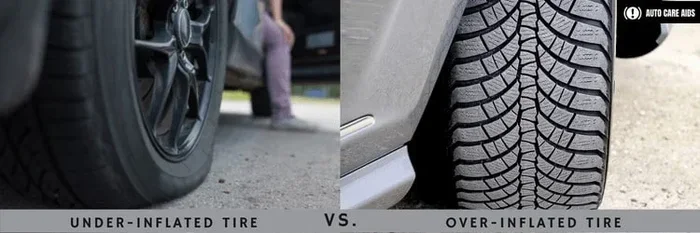
When a tire is overinflated, the center of the tread pushes harder into the road. This shrinks the contact patch. The contact patch is the area of rubber actually touching the ground. Less contact means less grip. On wet roads, this becomes even more dangerous because the tire cannot channel water away as effectively.
Think of it like a high-heel shoe versus a flat sneaker. The high heel concentrates all your weight on a tiny area. The sneaker spreads it out evenly. Your tires work the same way. Overinflation turns your tire into a high heel, and that hurts handling and braking.
Uneven and Accelerated Tire Wear
One of the first visible signs of overinflated tires is uneven wear. The center of the tread wears down much faster than the outer edges. This means your tire needs to be replaced sooner than it should. Premature tire replacement is an expensive and unnecessary cost.
Here is what to look for:
- Worn center tread: The middle of the tire looks smooth while the edges still have tread.
- Cupping or scalloping: In severe cases, you may see uneven patches of wear across the tread.
- Reduced tread depth: A simple penny test can reveal if the center is wearing faster than it should.
Uneven wear also affects how your car handles in emergency situations. A tire with uneven tread cannot grip the road as well during hard braking or sharp turns.
Increased Risk of Blowouts
This is the scariest consequence of tire pressure is too high. Overinflated tires are more rigid and less flexible. When you hit a pothole, a curb, or debris on the road, the tire cannot absorb the impact the way it was designed to. The energy goes straight into the tire sidewall and carcass.
Over time, this repeated stress weakens the tire. In the worst case, it causes a sudden blowout. A blowout at highway speeds can cause you to lose control of the vehicle entirely. This is why maintaining proper tire inflation is so important for every driver.
Harsher Ride Quality
Overinflated tires are stiff. They do not flex over bumps, potholes, or rough road surfaces the way they should. The result is a harsh, jarring ride that transmits every bump straight into the cabin. If your car suddenly feels stiffer and less comfortable, overinflation could be the culprit.
Ride comfort matters more than most people think. A harsh ride causes driver fatigue on long trips. It also puts extra stress on your car’s suspension components, which can lead to additional repair costs over time.
Reduced Braking Performance
Because overinflated tires have a smaller contact patch, they cannot grip the road as effectively during braking. Stopping distances increase, especially on wet or icy surfaces. This is a safety concern that many drivers overlook when they check their tire pressure.
In an emergency stop, every foot of braking distance matters. Even a small reduction in grip caused by overinflation can be the difference between a safe stop and a collision.
Can You Drive Safely With Overinflated Tires?
The short answer is yes, but it is not ideal. If your tire pressure is too high by just a couple of PSI, the risk is relatively low. You can drive a short distance to let some air out. But if the pressure is significantly above the recommended level, you should not drive far.
Here are some guidelines to follow:
- Slightly over (2-3 PSI): Generally safe for short drives, but you should let air out soon.
- Moderately over (5+ PSI): Avoid highway driving. The blowout risk increases noticeably.
- Severely over (10+ PSI): Do not drive at all. The tire is at serious risk of failure.
If you notice your tire pressure monitoring system warning light on the dashboard, take it seriously. The TPMS is designed to alert you when pressure is outside the safe range. Ignoring this light is one of the most common mistakes drivers make.
If you are unsure whether your tires are safe to drive on, it is always better to call for roadside assistance or visit a tire shop. Tire safety should never be taken lightly.
What Causes Tire Pressure to Be Too High?
Understanding the causes helps you prevent the problem from happening in the first place. Several common scenarios lead to overinflated tires.
Overfilling at the Gas Station
Air pumps at gas stations are not always accurate. The automatic shut-off sometimes triggers too early or too late. Many drivers add air without checking with a separate tire pressure gauge afterward. This is one of the leading causes of overinflated tires.
Temperature Changes
Air pressure inside a tire increases when the temperature rises. On a hot summer day, the air inside your tires expands. This can raise the PSI by several points. Conversely, cold weather in winter can cause pressure to drop. This is why it is important to check your tire pressure regularly with the seasons.
TPMS Sensor Issues
Sometimes the problem is not with the tire itself but with the sensor. A faulty tire pressure monitoring system sensor may give inaccurate readings. If your TPMS light keeps coming on even after you adjust the pressure, the sensor itself may need to be replaced. You can learn more about fixing TPMS issues in our guide on fixing your own tire pressure sensor.
Recent Tire Replacement
When you get new tires installed, the technician should set the pressure to the manufacturer’s recommendation. But mistakes happen. Always double-check your tire inflation after any tire service. A quick check with a gauge takes seconds and can prevent a lot of trouble.
How to Check and Correct Tire Pressure
Fixing overinflated tires is simple. The key is to catch the problem early and take the right steps. Here is a step-by-step guide.
- Get a reliable tire pressure gauge. Digital gauges are affordable and accurate. Do not rely solely on the gas station air pump gauge.
- Check the pressure when tires are cold. Park the car for at least three hours before checking.
- Compare the reading to the recommended PSI. Look at the door sticker or owner’s manual for the correct number.
- Release air if the pressure is too high. Press the small pin inside the valve stem to let out air. Do this in short bursts and recheck.
- Recheck after adjusting. Measure again to make sure you hit the target PSI.
If you are not comfortable doing this yourself, any tire shop or auto service center can check and adjust your tire pressure for a small fee or free. Many quick-lube shops will do it as part of an oil change service.
Also, remember that you should check all four tires, including the spare. A spare tire with incorrect pressure is useless when you need it most.
How Often Should You Check Tire Pressure?
The general rule is to check your tire pressure at least once a month. Tires naturally lose about 1 PSI per month through normal seepage. Temperature changes also affect pressure, so checking with the seasons is a smart habit.
Some experts recommend checking before every long trip. This is especially important for road trips where you will be driving for hours at a time on highways. A few minutes of checking can prevent a major safety issue on the road.
For vehicles equipped with a tire pressure monitoring system, the dashboard light will alert you if pressure drops significantly. But do not rely on TPMS alone. The system is a backup, not a replacement for regular manual checks.
Common Mistakes Drivers Make With Tire Pressure
Even careful drivers sometimes make mistakes when it comes to tire inflation. Here are the most common ones to avoid:
- Relying on the tire sidewall PSI: That number is the maximum, not the recommended pressure.
- Checking tires when they are hot: Driving heats up the air and raises the PSI reading, giving you a false sense of safety.
- Ignoring the TPMS light: That warning light exists for a reason. Do not ignore it.
- Only checking one or two tires: All four tires need to be at the correct pressure, including the spare.
- Overinflating for better fuel economy: While slightly higher pressure can marginally improve fuel economy, the safety risks far outweigh any small gains.
Avoiding these mistakes keeps your tires in good shape and your family safe on the road. If you ever notice your car showing an engine or system warning light and you are unsure whether it is safe to drive, check out our article on driving with an engine malfunction light for helpful guidance.
The Long-Term Cost of Ignoring Overinflated Tires
Some drivers think a little extra air in the tires is harmless. But over time, the damage adds up. Here is what ignoring overinflation can cost you:
| Issue | Short-Term Impact | Long-Term Impact |
|---|---|---|
| Uneven Wear | Slightly reduced tread life | Premature tire replacement |
| Blowout Risk | Increased on rough roads | Costly roadside repairs or accidents |
| Ride Quality | Harsher ride | Suspension component wear |
| Braking | Longer stopping distances | Increased accident risk |
| Fuel Economy | Slight improvement | Negligible savings vs. tire replacement cost |
As you can see, the long-term costs of ignoring overinflation far outweigh any small benefits. The best approach is to catch the problem early and correct it before it causes damage. If you are dealing with other car issues alongside tire concerns, such as oil-related questions, our guide on does it really matter what oil you put in your car is worth a read.
Expert Insights on Tire Pressure Maintenance
Automotive experts agree that proper tire inflation is one of the simplest and most effective ways to maintain your vehicle. Tire manufacturers, safety organizations, and mechanics all emphasize the importance of keeping pressure at the recommended level.
According to the National Highway Traffic Safety Administration, tire-related issues contribute to thousands of accidents every year. Many of these are directly linked to improper inflation, including tires that are tire pressure is too high. A well-maintained set of tires can last thousands of miles longer and keep you safer on every trip.
Experts also recommend rotating your tires every 5,000 to 7,500 miles. This helps ensure even wear across all four tires. Combined with proper tire pressure, regular rotation is one of the best investments you can make in your vehicle’s longevity and safety.
Quick Tips to Prevent Overinflation
Prevention is always easier than fixing a problem. Here are some quick tips to keep your tire pressure in the safe zone:
- Keep a quality tire gauge in your glove box.
- Check pressure once a month and before long trips.
- Always check when tires are cold for the most accurate reading.
- Do not use the max PSI on the tire sidewall as your target.
- Replace your TPMS sensors if they are more than 5 years old.
- Visit a trusted tire shop if you are unsure about your readings.
These simple habits take just a few minutes each month but can save you hundreds of dollars in tire replacements and, more importantly, keep you and your passengers safe.
Final Thoughts
Tire pressure is too high is a problem that affects more drivers than most people realize. The effects range from a harsh ride to dangerous blowouts. But the good news is that it is easy to prevent and simple to fix. A little awareness and a few minutes of regular checking go a long way.
Your tires are the only part of your car that touches the road. Treating them well with proper tire inflation pays off in safety, comfort, and savings. Do not let overinflation sneak up on you. Make tire pressure checks a regular part of your car maintenance routine.
If you found this guide helpful, share it with a friend or family member who might benefit from learning more about tire care. And remember, when in doubt about your vehicle’s health, always consult a trusted mechanic. Stay safe out there, and keep those tires properly inflated.
Frequently Asked Questions
Can overinflated tires cause a blowout?
Yes, tire pressure is too high significantly increases the risk of a blowout. Overinflated tires are stiffer and less able to absorb impacts from potholes, curbs, and road debris. This repeated stress weakens the tire sidewall and can lead to sudden failure, especially at higher speeds or under heavy loads.
How do I know if my tire pressure is too high?
You can check with a tire pressure gauge and compare the reading to the recommended PSI on your driver’s door sticker. Signs of overinflation include a harsh ride, reduced traction, and uneven wear in the center of the tread. Your TPMS light may also activate if the pressure is significantly above the safe range.
Does overinflation affect fuel economy?
Slightly overinflated tires can marginally improve fuel economy because there is less rolling resistance. However, the improvement is very small and does not outweigh the safety risks. Maintaining the manufacturer-recommended pressure is always the best approach for both fuel efficiency and safety.
What is the maximum PSI I should run in my tires?
Never run your tires at the maximum PSI listed on the tire sidewall. That number is the upper limit the tire can handle, not the recommended operating pressure. Always follow the recommended PSI found on your driver’s door frame or in the owner’s manual for the best performance and safety.
How often should I check my tire pressure?
Check your tire pressure at least once a month and before any long road trips. Tires naturally lose about 1 PSI per month, and temperature changes can also affect readings. Checking when the tires are cold gives you the most accurate measurement.
Can I fix overinflated tires myself?
Yes, fixing overinflated tires is simple. Use a tire pressure gauge to check the current PSI, then press the small pin inside the valve stem to release air in short bursts. Recheck the pressure after each release until you reach the recommended level. If you are not comfortable doing this, any tire shop can do it quickly and for free or a small fee.