How Bugattis Quad-Turbocharged Powerplant Works – Explained
Bugatti’s quad-turbocharged powerplant is one of the most impressive engines ever built. The W16 engine uses four turbochargers to produce over 1,000 horsepower. This system pushes Bugatti supercars to mind-blowing speeds that rival race cars. Understanding how this engine works helps car enthusiasts appreciate the engineering genius behind every push of the accelerator.
Bugatti has built some of the most legendary supercars on the planet. The Chiron, the Veyron, and the Mistral all share one thing in common. They all run on a quad-turbocharged powerplant that defies belief. When you press the accelerator in a Bugatti, you feel raw, unfiltered force pressing you back into the seat. But how does this incredible machine actually work? Let’s break it down in a way that makes sense for everyone.
The quad-turbocharged setup is not just about making noise. It is a carefully engineered system where every component plays a specific role. From the shape of the engine block to the size of the turbochargers, nothing is left to chance. If you have ever wondered what happens under the hood of a Bugatti, this guide will walk you through it step by step.
Key Takeaways
- Four Turbochargers Work as a Team: The quad-turbo setup ensures smooth, consistent power delivery across the entire RPM range.
- The W16 Configuration Is Unique: Four banks of four cylinders create a compact yet powerful engine layout that sets Bugatti apart.
- Advanced Cooling Is Essential: With so much heat generated, Bugatti uses sophisticated cooling systems to keep the engine running safely.
- Over 1,000 Horsepower Is the Standard: Modern Bugatti quad-turbo engines produce staggering power numbers that redefine supercar performance.
- Regular Maintenance Matters: Even the most powerful engines need proper care, just like any vehicle on the road.
- Turbocharger Technology Has Evolved: Bugatti uses twin-scroll and variable geometry turbos to minimize lag and maximize response.
📑 Table of Contents
- What Is a Quad-Turbocharged Engine?
- The W16 Engine Architecture
- How the Turbochargers Work Together
- Cooling and Heat Management Systems
- Power Output and Performance Numbers
- Maintenance and Care for a Quad-Turbo Engine
- How Bugatti’s Quad-Turbo System Compares to Other Engines
- The Future of Quad-Turbo Technology
- Conclusion
What Is a Quad-Turbocharged Engine?
A quad-turbocharged engine uses four separate turbochargers to force air into the combustion chambers. Normally, a naturally aspirated engine relies on atmospheric pressure to fill its cylinders with air. A turbocharger changes this by using exhaust gases to spin a compressor. That compressor pushes extra air into the engine. More air means more fuel can be burned. More fuel burned means more power.
Now imagine doing this with four turbochargers instead of one or two. That is exactly what Bugatti does. The result is an engine that produces enormous horsepower without feeling sluggish. There is virtually no lag. The power comes on strong and stays strong from low RPM all the way to the redline.
Why Four Turbochargers Instead of Two?
You might wonder why Bugatti chose four turbos instead of a simpler twin-turbo setup. The answer comes down to size and response. The W16 engine in a Bugatti is massive. It has 64 valves and four cylinder banks. A single pair of turbochargers would struggle to keep up with the airflow demands of such a large engine at low RPM.
By splitting the workload across four turbochargers, Bugatti achieves several benefits:
- Faster throttle response at low engine speeds
- More consistent boost pressure across the entire RPM range
- Reduced turbo lag because smaller turbos spool up quicker
- Better thermal management since each turbo handles less exhaust heat
Think of it like a team of four runners instead of two. Each runner carries a lighter load, and the team covers more ground faster. That is essentially what Bugatti did with its turbocharging system.
The W16 Engine Architecture
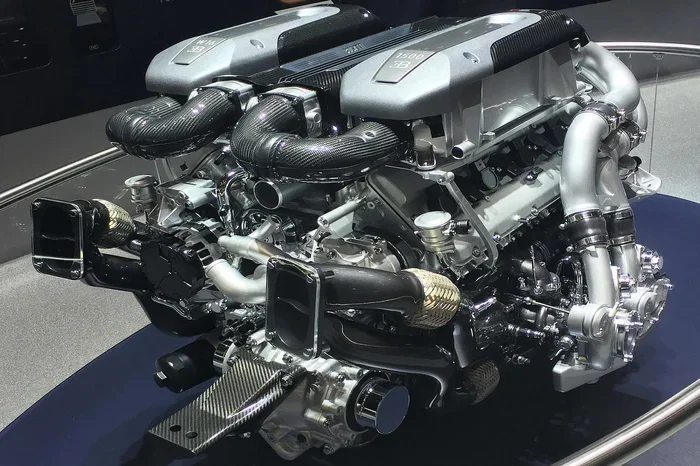
At the heart of every Bugatti quad-turbo car is the W16 engine. This engine is unlike anything else on the market. The name “W16” comes from the shape of the engine when viewed from the end. Four banks of cylinders are arranged in a W pattern. Each bank contains four cylinders. Together, they form a total of 16 cylinders.
The W16 engine displaces 8.0 liters. That is a huge amount of displacement for a car engine. For comparison, a typical V6 engine displaces around 3.5 liters. The Bugatti engine is more than twice that size. All that displacement, combined with four turbochargers, creates an absolute powerhouse.
How the Cylinder Banks Are Arranged
The four cylinder banks are arranged in a specific configuration. Two outer banks sit at wider angles, while the two inner banks sit at narrower angles. This creates the distinctive W shape. The arrangement keeps the engine relatively compact for its size. Without this clever design, a 16-cylinder engine would be enormous and impractical for a road car.
Each cylinder has four valves, two for intake and two for exhaust. That adds up to 64 valves total. This large valve count allows air to flow in and out of the cylinders very efficiently. Efficient airflow is critical when you are trying to make over 1,000 horsepower.
The engine block is made from a lightweight aluminum alloy. This helps keep the overall weight of the car manageable. After all, all that power would be useless if the car weighed as much as a tank. Bugatti engineers spent years perfecting the balance between strength and weight.
Engine Displacement and Its Role
Displacement refers to the total volume of all the cylinders combined. A larger displacement generally means more power potential. The 8.0-liter displacement of the Bugatti W16 gives the engine a broad, flat torque curve. This means the engine produces strong pulling power from low RPM all the way up high. You do not need to rev it to the moon to feel the force.
The quad-turbocharged setup enhances this even further. The turbos fill in any gaps where natural aspiration alone would fall short. The result is a smooth, linear delivery of power that feels almost supernatural behind the wheel.
How the Turbochargers Work Together
The four turbochargers in a Bugatti do not all work the same way at all times. The system is designed to be smart and adaptive. At low engine speeds, only the smaller turbochargers may be active. As RPM increases, the larger turbochargers kick in to provide additional boost. This staged approach helps eliminate turbo lag entirely.
Each turbocharger consists of two main parts. The turbine side is connected to the exhaust manifold. Exhaust gases spin the turbine, which is connected by a shaft to the compressor side. The compressor pulls in fresh air and compresses it before sending it into the intake manifold. More compressed air means more oxygen in the cylinders, which allows more fuel to be injected and burned.
Twin-Scroll Technology
Bugatti uses twin-scroll turbochargers in its quad-turbo system. In a traditional turbo, exhaust gases from all cylinders feed into a single scroll. This can cause interference between pulses of exhaust. Twin-scroll turbos separate the exhaust pulses, so they do not clash with each other. This improves efficiency and response.
The twin-scroll design gives the engine a more immediate power delivery. When you step on the gas, the turbos respond almost instantly. You do not have to wait for them to spool up. This is a key reason why Bugatti engines feel so lively despite their enormous size.
If you have ever driven a NASCAR race car, you know how important engine response is at high speeds. Bugatti applies similar principles of forced induction to deliver seamless power on the road.
Boost Pressure and Its Importance
Boost pressure is the amount of extra air the turbochargers push into the engine. Higher boost means more power, but it also means more heat. Bugatti carefully manages boost pressure through an electronic control system. Sensors monitor engine conditions in real time and adjust the boost accordingly.
Under normal driving conditions, the boost is moderate. But when you floor it, the system delivers maximum boost for a dramatic surge of power. This electronic management ensures the engine stays safe while still delivering exhilarating performance.
Cooling and Heat Management Systems
All that power generates a tremendous amount of heat. If the engine overheats, it can cause serious damage. This is why Bugatti puts so much focus on cooling. The quad-turbocharged powerplant uses multiple cooling systems working together to keep temperatures in check.
You might ask, how hot can a car actually get? In a Bugatti running at full throttle, engine temperatures can reach extreme levels. The cooling system is specifically designed to handle these conditions without breaking a sweat.
The Intercooler System
When air is compressed by the turbochargers, it heats up. Hot air is less dense than cool air, which means it contains less oxygen. To fix this, Bugatti uses a large intercooler system. The intercooler acts like a radiator for the intake air. It cools the compressed air before it enters the engine.
Cooler intake air is denser, which means more oxygen per volume. More oxygen allows the engine to burn fuel more efficiently. This directly translates to more power and better fuel combustion. The intercoolers in a Bugatti are massive and strategically placed for maximum airflow.
Liquid Cooling for the Turbos
The turbochargers themselves also generate extreme heat. Bugatti uses a dedicated liquid cooling circuit for the turbos. Coolant circulates through channels in the turbo housing to absorb heat. This keeps the turbochargers operating within their optimal temperature range.
Without proper turbo cooling, the components could warp or fail under the intense conditions. Bugatti’s engineers designed the cooling system to handle sustained high-speed driving, which is exactly what these cars are built for.
Oil Cooling and Lubrication
Engine oil plays a dual role in a Bugatti. It lubricates the moving parts and also helps carry heat away from critical components. The oil cooling system in a Bugatti is a high-capacity setup that includes a large oil cooler. This cooler is similar in concept to a radiator but specifically designed for oil temperature management.
Regular oil changes and proper engine maintenance are essential for keeping any high-performance car healthy. Bugatti owners should follow the manufacturer’s service schedule closely to ensure the quad-turbo engine stays in peak condition for years.
Power Output and Performance Numbers
Now let us talk about the numbers. This is what most enthusiasts want to know. How much power does the quad-turbocharged Bugatti engine actually make? The answer depends on the specific model, but the numbers are always impressive.
The latest Bugatti models produce well over 1,000 horsepower. Some configurations push close to 1,500 horsepower. That is more power than most sports cars, sedans, and even some trucks combined. The torque figures are equally staggering, often exceeding 1,000 pound-feet.
Acceleration and Top Speed
With that much power, the acceleration is breathtaking. Bugatti supercars can go from 0 to 60 mph in around 2.3 seconds. The top speed is electronically limited, but it exceeds 260 mph in most models. For context, that is faster than most NASCAR vehicles on a standard oval track.
The quad-turbo setup is the key to achieving these numbers. A naturally aspirated engine of the same displacement would struggle to reach even half of these figures. The turbochargers effectively double or triple the engine’s output by forcing more air into the combustion process.
Power Delivery and Drivetrain
All that power goes to the wheels through an all-wheel-drive system. This is important because 1,000+ horsepower can easily overwhelm a two-wheel-drive setup. The AWD system distributes power to all four tires, giving the car incredible grip and stability.
The transmission is a dual-clutch automatic with seven or eight speeds. It shifts gears in milliseconds. You barely even notice the shifts happening. This seamless power delivery is what makes Bugatti so special. The car pulls hard from a standstill and keeps pulling hard at top speed.
Maintenance and Care for a Quad-Turbo Engine
Owning a Bugatti comes with responsibilities. The quad-turbocharged engine is a complex machine that requires regular care and attention. Skipping maintenance can lead to expensive repairs or reduced performance over time.
Regular Service Intervals
Bugatti recommends strict service intervals for their vehicles. Oil changes, filter replacements, and inspections should be performed on schedule. The turbochargers are especially sensitive to oil quality. Dirty or degraded oil can cause premature wear on the turbo bearings.
Here are some key maintenance tasks for a Bugatti owner:
- Oil changes every 10,000 miles using manufacturer-specified synthetic oil
- Air filter replacements at regular intervals to ensure clean airflow
- Coolant system flushes to prevent overheating and corrosion
- Turbo inspection during major service visits
- Brake system checks since high-speed driving puts extra stress on brakes
Just like any car, the more diligently you maintain it, the longer it will last. Some owners keep their Bugattis for decades with proper care. The engine can easily surpass 100,000 miles if serviced correctly. That is a far cry from the days when a high-performance engine was expected to give out after 50,000 miles.
Common Issues to Watch For
While Bugatti engines are incredibly well-built, they are not immune to problems. Some common issues include:
- Turbo wastegate sticking if the engine is not warmed up properly
- Oil leaks around turbo seals over time
- Intercooler clogging from debris or dirt accumulation
- Sensor failures in the boost pressure monitoring system
Most of these issues can be avoided with regular inspections and prompt attention to warning signs. If you notice a drop in performance, unusual noises, or warning lights on the dashboard, get the car checked immediately.
How Bugatti’s Quad-Turbo System Compares to Other Engines
To truly appreciate Bugatti’s engineering, it helps to compare it to other high-performance engines. Many supercars use twin-turbo V8 or V10 engines. These setups are proven and effective. But the quad-turbo W16 takes things to another level entirely.
| Feature | Bugatti W16 Quad-Turbo | Twin-Turbo V8 | Naturally Aspirated V12 |
|---|---|---|---|
| Cylinders | 16 | 8 | 12 |
| Turbochargers | 4 | 2 | 0 |
| Displacement | 8.0L | 4.0L | 6.0L |
| Horsepower | 1,000-1,500+ | 500-700 | 600-800 |
| Top Speed | 260+ mph | 200 mph | 200 mph |
The comparison shows why Bugatti stands in a class of its own. The quad-turbo W16 delivers significantly more power and speed than competing configurations. It is a true engineering masterpiece that pushes the boundaries of what is possible in a road-legal car.
The Future of Quad-Turbo Technology
Bugatti continues to push the envelope with each new model. The latest Chiron Super Sport 300+ proved that quad-turbo technology can push past the 300 mph barrier. As emissions regulations tighten and electrification becomes more common, Bugatti faces new challenges. But the company has shown it can adapt while maintaining its commitment to extreme performance.
Hybrid and electric powertrains may eventually join the quad-turbo formula. Imagine a Bugatti with electric motors assisting the turbocharged engine for instant torque. The possibilities are exciting, and Bugatti has the engineering pedigree to make them a reality.
For now, the quad-turbocharged W16 remains the gold standard in automotive engineering. It represents the pinnacle of internal combustion technology. Every time a Bugatti roars past on the highway, it carries with it decades of innovation and obsession with speed.
Conclusion
Bugatti’s quad-turbocharged powerplant is a marvel of modern engineering. The combination of a massive W16 engine with four precision turbochargers creates a driving experience unlike anything else. From the staged turbo activation to the advanced cooling systems, every detail is designed for one purpose. Maximum power. Maximum performance. Maximum excitement.
Whether you are a car enthusiast or simply curious about how these machines work, the quad-turbo Bugatti engine is worth understanding. It represents the absolute peak of what internal combustion technology can achieve. And while the automotive world is shifting toward electrification, the legacy of the Bugatti W16 will live on as a testament to human ingenuity and the relentless pursuit of speed.
Frequently Asked Questions
What does quad-turbocharged mean?
Quad-turbocharged means the engine uses four turbochargers instead of one or two. Each turbo helps compress air that enters the engine, allowing more fuel to be burned and creating significantly more power. Bugatti uses this setup in its W16 engine to achieve over 1,000 horsepower.
How much horsepower does a Bugatti quad-turbo engine produce?
Most modern Bugatti models produce between 1,000 and 1,500 horsepower depending on the specific configuration. The exact number varies by model and year, but every Bugatti with a quad-turbo engine delivers mind-blowing performance figures that place them among the fastest cars in the world.
Why does Bugatti use four turbochargers instead of two?
Bugatti uses four turbochargers because the W16 engine is very large at 8.0 liters. Four smaller turbos provide faster response and better airflow than two larger ones. This setup virtually eliminates turbo lag and ensures smooth power delivery across the entire RPM range.
How hot does a Bugatti engine get?
A Bugatti engine running at full throttle can reach extremely high temperatures, often exceeding 200 degrees Fahrenheit. The cooling system, including large intercoolers and a dedicated oil cooler, is specifically designed to handle these extreme conditions safely and consistently.
How often does a Bugatti quad-turbo engine need service?
Bugatti recommends regular service intervals, typically every 10,000 miles for oil changes and major inspections. Following the manufacturer’s maintenance schedule is critical for keeping the turbocharged engine running reliably and preventing costly repairs down the road.
Can a quad-turbo engine last a long time?
Yes, with proper maintenance, a Bugatti quad-turbo engine can last well over 100,000 miles. The key is staying on top of oil changes, coolant flushes, and turbo inspections. Regular care ensures the turbochargers and engine internals remain in excellent condition for the long haul.