Car AC Parts Name A Complete Visual Guide For Beginners
Knowing your car ac parts name helps you understand how your vehicle cools down on hot days. This guide covers every major component from the compressor to the evaporator. You will learn how each part works, common problems, and simple maintenance tips. Whether you are a beginner or a car owner, this visual guide makes it easy to follow along.
Have you ever wondered what makes the air inside your car feel cool and fresh? Your car ac parts name list is longer than you might think. Each component plays a specific role in the cooling process. Together, they form a system that works hard every time you turn that knob to cold.
Whether your ac is acting up or you just want to understand your vehicle better, knowing the parts is the first step. This guide walks you through every major component in simple terms. No engineering degree needed. Just clear, practical information that makes sense.
We will cover the compressor, condenser, evaporator, and much more. You will also learn how these parts connect and why each one matters. By the end, you will have a solid understanding of your entire car air conditioning system.
Key Takeaways
- Complete Parts List: You will learn all the essential car ac parts name and their roles in the cooling system.
- How It Works: Understand the step-by-step process of how your car air conditioning system keeps you cool.
- Troubleshooting Help: Identify common car ac problems linked to specific components.
- Maintenance Tips: Simple habits that extend the life of your car ac parts and improve performance.
- Replacement Guidance: Know when to repair versus replace each component of your vehicle ac system.
- Beginner-Friendly: No technical jargon overload. This guide is written for everyday car owners.
📑 Table of Contents
Understanding Your Car AC System
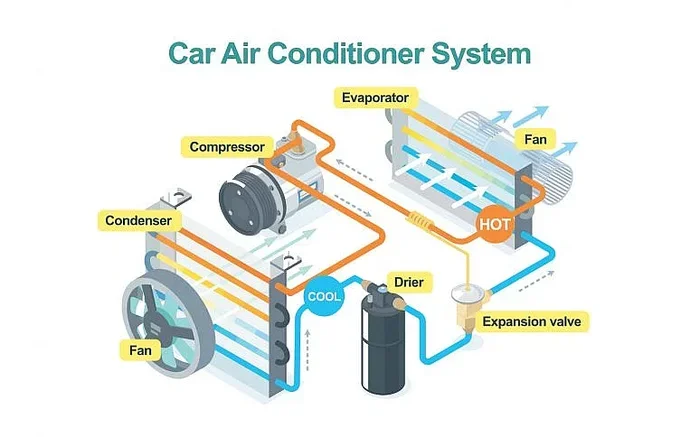
Before diving into the car ac parts name list, it helps to see the big picture. Your car ac works like a mini refrigerator. It moves heat from inside your cabin to the outside. This process relies on a refrigerant, which is a special fluid that changes from gas to liquid and back again.
The system has two main sides. The high-pressure side pushes the refrigerant through. The low-pressure side lets it expand and cool down. Each part on both sides has a job to do. When one part fails, the whole system suffers.
Think of it like a circle. The refrigerant flows in a loop. It compresses, condenses, expands, and evaporates over and over. Understanding this loop makes it easier to remember each car ac parts name. Let us break it down piece by piece.
Why Knowing Your AC Parts Matters
When your car ac stops blowing cold air, the first question is always “what is wrong?” Without knowing the car ac parts name, you might guess blindly. You could end up replacing the wrong part or paying a mechanic too much. When you know the parts, you can have better conversations with repair shops.
You can also spot small problems early. A tiny leak in an ac hose can turn into a big repair if you ignore it. Catching issues early saves money. It also keeps your vehicle ac system running smoothly all year long.
The Core Car AC Parts Name List
Here is where the real learning begins. This section covers every major component you will find in a typical vehicle ac system. Each part gets its own spotlight so you can really understand what it does.
1. AC Compressor
The ac compressor is often called the heart of the system. It pumps the refrigerant through the loop. Without it, nothing moves and nothing cools. When you turn on your car ac, the compressor clutch engages and starts spinning.
The compressor takes in low-pressure gas and squeezes it into high-pressure gas. This process heats up the refrigerant. That heat is then moved outside your car. If your compressor fails, your entire car ac parts name chain stops working.
Common signs of a bad compressor include strange noises, warm air from the vents, and fluid leaks. Regular maintenance can help your compressor last a long time.
2. Condenser
The condenser sits right in front of your radiator. It looks like a small radiator itself. Its job is to release heat from the hot refrigerant gas. As air flows through the condenser, the gas cools down and turns into a liquid.
Think of the condenser as the part that “sweats out” the heat. It works hard when you are driving fast because there is more airflow. At low speeds, the cooling fans help push air through.
Debris, bugs, and dirt can block the condenser fins. This reduces airflow and makes your ac less efficient. Keeping the condenser clean is a simple but effective car ac maintenance habit.
3. Evaporator
The evaporator is located inside your dashboard, behind the glove box. This is the part that actually cools the air you breathe. As the cold refrigerant flows through the evaporator, it absorbs heat from the cabin air.
The blower motor pushes air across the evaporator fins. That air comes out cold through your vents. The evaporator also removes moisture, which is why your ac helps defog your windshield.
Evaporators are tricky to replace because they are tucked deep inside the dashboard. If you notice a musty smell or weak airflow, your evaporator might be the culprit. This is one of the more expensive parts on the car ac parts name list to fix.
4. Expansion Valve or Orifice Tube
The expansion valve or orifice tube is a small but vital part. It sits between the condenser and the evaporator. Its job is to regulate the flow of refrigerant into the evaporator. It drops the pressure of the liquid refrigerant so it can expand and cool.
Not all cars use the same part. Some vehicles have a thermal expansion valve, while others use a fixed orifice tube. The expansion valve adjusts based on temperature. The orifice tube stays the same size at all times.
A clogged or faulty expansion valve can cause your ac to blow warm air. It can also lead to frost building up on the evaporator. This is a common issue that mechanics check during car ac repair visits.
5. Receiver Dryer or Accumulator
The receiver dryer or accumulator acts as a storage and filtering unit. It sits between the condenser and the expansion valve. It removes moisture from the refrigerant and catches any debris or contaminants.
Moisture is the enemy of your ac system. It can cause corrosion and blockages. The receiver dryer uses a desiccant material to absorb that moisture. Over time, the desiccant can become saturated and stop working.
Most experts recommend replacing the receiver dryer every time your system is opened for repair. It is a small part that protects the entire vehicle ac system from damage.
6. AC Clutch
The ac clutch connects and disconnects the compressor from the engine. When you turn on the ac, the clutch engages and spins the compressor pulley. When you turn it off, the clutch disengages so the compressor stops.
This clever design saves fuel when you do not need cooling. The clutch uses electromagnetic energy to engage. If the clutch fails, the compressor will not spin even if the ac is turned on.
You might hear a clicking sound when the clutch engages and disengages. A worn clutch can cause slipping or complete failure. It is an important part to check during any car ac parts name inspection.
7. Blower Motor
The blower motor is the fan that pushes air through your vents. It sits behind the dashboard and is controlled by the fan speed switch. Without the blower motor, the cold air from the evaporator would have no way to reach you.
Blower motors can wear out over time. You might notice rattling, weak airflow, or no air at all at certain speeds. Replacing a blower motor is usually straightforward and affordable compared to other ac components.
8. Refrigerant
Refrigerant is the lifeblood of your ac system. It is the fluid that actually creates the cooling effect. The most common types used in cars are R-134a and the newer R-1234yf. Your vehicle will specify which type it uses.
The refrigerant cycles through the system over and over. It never gets “used up” under normal conditions. If your ac is low on refrigerant, there is likely a leak somewhere. Simply adding refrigerant without fixing the leak is not a real solution.
9. AC Hoses and Lines
AC hoses and lines connect all the major parts together. They carry the refrigerant from one component to the next. These rubber and metal lines handle high pressure and temperature changes every day.
Over time, hoses can crack, swell, or develop leaks. The rubber seals and O-rings at connection points are especially vulnerable. Inspecting your ac hoses during regular maintenance can prevent unexpected breakdowns on a hot day.
10. Cabin Air Filter
The cabin air filter is not part of the ac cooling system itself, but it plays a big role in airflow quality. It filters dust, pollen, and debris from the air before it enters your cabin. A clogged cabin filter reduces airflow and makes your ac work harder.
Replacing your cabin air filter is one of the easiest maintenance tasks you can do. Most vehicles have the filter located behind the glove box or under the hood. Check your owner manual for the exact location and replacement schedule.
How Each Part Works Together
Now that you know the car ac parts name, let us see how they work as a team. The process starts when you press the ac button on your dashboard.
- The ac clutch engages and starts spinning the ac compressor.
- The compressor pressurizes the refrigerant gas and sends it through the ac hoses.
- The hot, high-pressure gas flows into the condenser, where it releases heat and becomes a liquid.
- The liquid refrigerant passes through the receiver dryer, which removes moisture and filters out debris.
- Next, it reaches the expansion valve or orifice tube, which drops the pressure and causes the refrigerant to cool significantly.
- The cold, low-pressure liquid enters the evaporator, where it absorbs heat from the cabin air.
- The blower motor pushes the cooled air through your vents and into the cabin.
- The refrigerant, now warm again, turns back into a gas and returns to the compressor to start the cycle over.
Every part in this sequence matters. If one fails, the whole process breaks down. This is why understanding each car ac parts name helps you troubleshoot problems more effectively.
Common Car AC Problems and Their Parts
Knowing the car ac parts name helps you connect symptoms to specific problems. Here are the most common issues and which parts they affect.
AC Blows Warm Air
Warm air from the vents is the most common ac complaint. It can be caused by low refrigerant, a failing compressor, or a clogged expansion valve. Sometimes it is as simple as a tripped ac pressure switch. A mechanic can check the refrigerant level and inspect each part to find the root cause.
Weak Airflow from Vents
If the air feels weak or barely blows, the problem is often the blower motor or a clogged cabin air filter. Debris can also block the evaporator case. Checking these parts first can save time and money on diagnostics.
Strange Noises When AC Is On
Grinding, squealing, or clicking sounds usually point to the ac compressor or ac clutch. A worn compressor bearing or a failing clutch can make distinct noises. Do not ignore these sounds. They often get worse over time and lead to more expensive repairs.
Moisture or Mildew Smell
A musty smell usually comes from a dirty or moldy evaporator. The evaporator collects moisture during operation, and that moisture can breed mold if not drained properly. Cleaning the evaporator or replacing the cabin air filter often solves this problem.
Car AC Maintenance Tips
Proper care keeps your car ac parts name list functioning at its best. Here are some simple tips every car owner should follow.
- Run your ac regularly: Even in winter, run the ac for about 10 minutes every few weeks. This keeps the seals and compressor lubricated.
- Check refrigerant levels: Low refrigerant is the number one cause of poor ac performance. Have a professional check the levels during your annual service.
- Replace the cabin air filter: A clean filter improves airflow and air quality. Replace it every 12,000 to 15,000 miles or as recommended in your owner manual.
- Keep the condenser clean: Hose down the front of your car to remove dirt, bugs, and debris from the condenser fins.
- Inspect ac hoses: Look for cracks, swelling, or wet spots around hose connections. Early detection prevents refrigerant leaks.
- Address small problems quickly: A small leak today can become a compressor failure tomorrow. Fix minor issues before they grow.
When to Replace Car AC Parts
Not every ac problem requires a full replacement. But some parts wear out over time and need to be swapped out. Knowing the car ac parts name helps you understand which parts are most likely to fail and when.
The ac compressor typically lasts 8 to 10 years or 100,000 miles with proper care. The condenser and evaporator can last even longer if you keep the system clean. AC hoses and rubber seals are more vulnerable and may need replacement every 5 to 7 years.
The receiver dryer should always be replaced whenever the system is opened for repair. Moisture exposure during the process can compromise the desiccant. Replacing it is inexpensive compared to the damage moisture can cause to other components.
If you are dealing with a car ac not blowing cold air situation, start by checking the simple things. Verify the refrigerant level. Replace the cabin air filter. Make sure the blower motor works. If those checks do not solve the problem, it is time for a professional diagnosis.
Comparison Table: Key Car AC Parts
| Part | Location | Main Function | Typical Lifespan |
|---|---|---|---|
| AC Compressor | Front of engine | Pumps refrigerant through the system | 8-10 years |
| Condenser | Front of radiator | Releases heat from refrigerant | 10+ years |
| Evaporator | Inside dashboard | Cools cabin air | 10+ years |
| Expansion Valve | Between condenser and evaporator | Regulates refrigerant flow | 8-12 years |
| Receiver Dryer | Between condenser and valve | Filters moisture and debris | Replace with each repair |
| AC Clutch | On compressor pulley | Engages and disengages compressor | 8-10 years |
| Blower Motor | Behind dashboard | Pushes air through vents | 5-10 years |
| Refrigerant | Throughout the system | Creates the cooling effect | Does not get used up |
| AC Hoses | Connecting all parts | Carries refrigerant between components | 5-7 years |
| Cabin Air Filter | Behind glove box or under hood | Filters incoming air | 12-15K miles |
This table covers the most important car ac parts name you need to know. Keep it handy when you are discussing repairs with a mechanic or shopping for replacement parts.
Expert Insights on Car AC Care
Experienced mechanics agree that prevention is always better than repair when it comes to your vehicle ac system. Here are some expert-backed tips to keep in mind.
First, do not ignore the warning signs. If you notice any drop in cooling performance, get it checked right away. Running your ac on low refrigerant can damage the compressor over time. The compressor needs proper lubrication, and low refrigerant levels mean less lubricant reaching the internal parts.
Second, invest in quality parts. Cheap replacement ac hoses or receiver dryers may save money upfront but can fail sooner. OEM or high-quality aftermarket parts tend to last longer and perform better. This is especially true for seals and O-rings, which are critical for preventing leaks.
Third, stay on top of your car ac maintenance schedule. A professional ac inspection every year or two can catch small issues before they become big problems. Many shops offer affordable ac check services that include pressure testing and refrigerant level checks.
Conclusion
Learning the car ac parts name list is one of the most useful things you can do as a car owner. Each component from the ac compressor to the cabin air filter plays a vital role in keeping you cool and comfortable. When you understand how these parts work together, you become a smarter driver and a more informed consumer.
Use this guide to identify parts, troubleshoot problems, and have better conversations with your mechanic. Follow the maintenance tips to keep your system running strong for years to come. A well-maintained car air conditioning system makes every drive more enjoyable, especially on those hot summer days.
Start by memorizing the core parts. Then build your knowledge from there. You do not need to be a mechanic to understand your vehicle. With the information in this guide, you are already well on your way to becoming an expert on your own car ac parts name and how they keep you cool.
Frequently Asked Questions
What are the main car AC parts name I should know?
The most important parts include the ac compressor, condenser, evaporator, expansion valve, receiver dryer, ac clutch, blower motor, refrigerant, ac hoses, and cabin air filter. Each part plays a specific role in the cooling process and understanding them helps you troubleshoot problems more effectively.
Why is my car AC blowing warm air?
Warm air usually means low refrigerant, a failing compressor, a clogged expansion valve, or a malfunctioning ac clutch. It can also be caused by a blocked condenser or a broken ac pressure switch. A professional inspection can pinpoint the exact cause quickly.
How often should I maintain my car AC system?
You should have your ac system inspected at least once a year, ideally before summer. Replace the cabin air filter every 12,000 to 15,000 miles. Running your ac for 10 minutes regularly, even in winter, helps keep all the seals and components lubricated.
Can I drive with a broken AC compressor?
Yes, you can drive, but it is not recommended for long. A failing compressor can affect other parts of the system, including the ac belt and pulley. It can also lead to refrigerant leaks that damage the entire vehicle ac system over time.
How much does it cost to replace car AC parts?
Costs vary widely depending on the part. A cabin air filter might cost $20 to $50. An ac compressor can range from $500 to $1,000 including labor. The evaporator is one of the most expensive parts to replace, often costing $500 to $1,500. Always get a detailed quote before approving repairs.
What refrigerant does my car use?
Most cars made after 1994 use R-134a refrigerant. Newer vehicles, especially those made after 2021, may use R-1234yf. Check your owner manual or look under the hood for a sticker that specifies the correct refrigerant type for your vehicle.