A Car Starts from Rest and Accelerates Uniformly Explained
When a car starts from rest and accelerates uniformly, it begins at zero velocity and gains speed at a constant rate. This guide covers the three essential kinematic equations, step-by-step problem-solving methods, real-world examples, and common mistakes to avoid. You will learn how to calculate final velocity, displacement, and acceleration with confidence for any uniform acceleration scenario.
Key Takeaways
- A car starting from rest means initial velocity is zero: this simplifies all kinematic equations and makes calculations much easier.
- Uniform acceleration means steady speed increase: the car gains equal velocity in equal time intervals, which is the foundation of motion physics.
- Three key formulas govern this type of motion: v = at, s = ½at², and v² = 2as are all you need to solve most problems.
- Real-world examples make the math tangible: from family sedans to sports cars and EVs, uniform acceleration applies to everyday driving situations.
- Avoiding common mistakes saves time and improves accuracy: watch your units, signs, and formula choices carefully.
- Engineers use these same principles daily: from vehicle design to crash testing, uniform acceleration is a practical tool in the automotive world.
- Practice builds confidence: the more problems you solve, the more natural acceleration calculation becomes.
📑 Table of Contents
- What Does It Mean When a Car Starts from Rest and Accelerates Uniformly?
- The Key Formulas You Need to Know
- Step-by-Step: How to Solve Uniform Acceleration Problems
- Real-World Examples of Uniform Acceleration in Cars
- How Uniform Acceleration Differs from Other Types of Motion
- Common Mistakes People Make with These Problems
- Expert Insights: How Engineers Use Uniform Acceleration
- Key Takeaways
- Conclusion
What Does It Mean When a Car Starts from Rest and Accelerates Uniformly?
Let us start with the basics. When we say a car starts from rest, we mean its initial velocity is zero. The car is not moving at all before it begins to speed up. This is a key starting point for every uniform acceleration problem.
Uniform acceleration means the rate of change of speed stays the same over time. The car does not speed up fast at first and then slow down. It gains equal amounts of speed in equal time intervals. Think of it like a treadmill that slowly increases its speed by the same amount every second.
Why Does This Matter in Real Life?
Many real-world situations involve constant acceleration. When a driver presses the gas pedal at a steady pressure, the car often experiences near-uniform acceleration. This idea also applies to trains, elevators, and even rockets during certain phases of flight.
Understanding this concept helps you:
- Calculate how far a car travels while speeding up
- Predict how long it takes to reach a certain speed
- Understand the forces involved in car acceleration
- Solve physics problems with confidence
- Appreciate the engineering behind vehicle performance
The Key Formulas You Need to Know
There are three main kinematic equations that apply when a car starts from rest and accelerates uniformly. Since the initial velocity is zero, these formulas become much simpler. Let us walk through each one.
Formula 1: Final Velocity
The first formula relates final velocity to acceleration and time. It looks like this:
v = u + at
Since the car starts from rest, u equals zero. So the formula simplifies to v = at. This means the final velocity equals acceleration multiplied by time. If a car accelerates at 3 meters per second squared for 5 seconds, its final velocity is 15 meters per second.
Formula 2: Distance Traveled
The second formula calculates displacement, or how far the car travels. The full formula is:
s = ut + ½at²
Again, since u is zero, this becomes s = ½at². This tells us the distance depends on acceleration and the square of time. Double the time, and the distance quadruples. That is a powerful insight for anyone studying motion physics.
Formula 3: Velocity and Displacement
The third formula connects velocity directly to displacement without involving time:
v² = u² + 2as
With zero initial velocity, it becomes v² = 2as. This is handy when you know the distance but not the time. It is one of the most useful shortcuts in acceleration calculation.
Step-by-Step: How to Solve Uniform Acceleration Problems
Solving problems about a car starting from rest and accelerating uniformly follows a clear pattern. Once you know the steps, you can handle almost any question that comes your way.
Step 1: Identify What You Know
Write down the values you have been given. Usually, you will know some combination of:
- Initial velocity (which is zero for a car starting from rest)
- Acceleration (the steady rate of speed increase)
- Time (how long the car has been accelerating)
- Distance or displacement (how far the car traveled)
Step 2: Choose the Right Formula
Match your known values to the correct kinematic equation. If you have time and acceleration, use v = at. If you have acceleration and distance, try v² = 2as.
Step 3: Plug in the Numbers
Substitute your values into the formula. Always use consistent units. If acceleration is in meters per second squared, make sure distance is in meters and time is in seconds.
Step 4: Solve and Check
Do the math carefully. Then ask yourself: does this answer make sense? A car accelerating at 2 m/s² for 10 seconds should reach 20 m/s, which is about 72 km/h. That feels right for a typical sedan.
Quick Tips for Problem Solving
- Always write down what you know before picking a formula
- Draw a simple diagram showing the car, direction of motion, and known values
- Convert all units to the same system before calculating
- Double-check that your final velocity and displacement values are reasonable
- Practice with different numbers to build your confidence
Real-World Examples of Uniform Acceleration in Cars
Theory is great, but seeing how a car starts from rest and accelerates uniformly in real situations makes it click. Let us look at a few practical examples.
Example 1: A Family Sedon Pulling Away from a Stoplight
Imagine a sedan at a red light. The light turns green, and the driver presses the gas pedal steadily. The car accelerates at 2.5 m/s² for 8 seconds. How fast is it going, and how far has it traveled?
Final velocity: v = at = 2.5 × 8 = 20 m/s (about 72 km/h)
Distance traveled: s = ½at² = ½ × 2.5 × 64 = 80 meters
That is roughly the length of a football field. The car covered 80 meters in just 8 seconds, starting from a complete stop.
Example 2: A Sports Car Launching from a Standstill
Now imagine a sports car with a more powerful engine. It accelerates at 5 m/s² for 6 seconds. What are its speed and distance?
Final velocity: v = 5 × 6 = 30 m/s (about 108 km/h)
Distance traveled: s = ½ × 5 × 36 = 90 meters
Notice how the sports car reaches a much higher speed in a shorter distance. This is why high-performance vehicles feel so thrilling — the rate of change of velocity is much greater.
Example 3: An Electric Vehicle with Smooth Acceleration
Electric vehicles are known for their instant torque and smooth speed increase. Many EVs deliver nearly uniform acceleration from a stop. If an EV accelerates at 3 m/s² for 10 seconds:
Final velocity: v = 3 × 10 = 30 m/s (108 km/h)
Distance: s = ½ × 3 × 100 = 150 meters
EVs make this type of calculation especially relevant because their acceleration profile is so consistent and smooth.
How Uniform Acceleration Differs from Other Types of Motion
Not all motion is the same. Understanding how uniform acceleration compares to other types of motion helps deepen your grasp of force and motion.
Uniform vs. Non-Uniform Acceleration
With uniform acceleration, the speedometer reading increases by equal amounts each second. With non-uniform acceleration, the rate of speed change varies. Think of a car in heavy traffic — it speeds up, slows down, speeds up again. That is non-uniform acceleration.
Uniform Acceleration vs. Uniform Velocity
Uniform velocity means the car moves at a constant speed in a straight line. There is no acceleration at all. Uniform acceleration, on the other hand, means the speed is constantly changing by the same amount each second. These are two very different states of motion physics.
Uniform Acceleration vs. Deceleration
Deceleration is just negative acceleration. The car is still following the same kinematic equations, but the acceleration value is negative. When a car brakes steadily from a certain speed, it experiences uniform deceleration.
Common Mistakes People Make with These Problems
Even careful students trip up on uniform acceleration problems. Here are the most common errors and how to avoid them.
Forgetting That Initial Velocity Is Zero
The whole point of a car starting from rest is that the initial velocity equals zero. If you accidentally use a non-zero value, your answers will be wrong every time. Always double-check this first.
Mixing Up Units
Acceleration is often given in meters per second squared, but speed might be asked in kilometers per hour. Always convert before you calculate. Mixing units is the number one source of errors in acceleration calculation.
Using the Wrong Formula
Each kinematic equation has a specific purpose. If you need to find distance and you do not have time, do not use the formula that requires time. Pick the formula that matches your known and unknown values.
Ignoring the Direction of Motion
Acceleration is a vector quantity, which means it has direction. When a car moves forward and speeds up, acceleration is positive. When it brakes, acceleration is negative. Getting the sign wrong flips your answer in the wrong direction.
Rounding Too Early
Carry all decimal places through your calculation, and only round at the very end. Rounding too early can throw off your final answer significantly.
Expert Insights: How Engineers Use Uniform Acceleration
Automotive engineers use these same kinematic equations every day. They design engines, test safety features, and set performance benchmarks using the physics of car acceleration. When an engineer wants to know how long it takes a new model to reach 100 km/h from a standstill, they apply these exact formulas.
Crash test analysts also rely on uniform acceleration concepts. They calculate how quickly a vehicle decelerates during a collision, which directly affects safety ratings and restraint system design. The rate of change of velocity during impact determines the forces passengers experience.
Race car engineers take this even further. They fine-tune acceleration profiles to ensure the car gains speed as efficiently as possible off the starting line. Even small improvements in uniform acceleration can mean the difference between winning and losing a race.
Quick Tips for Understanding Uniform Acceleration Better
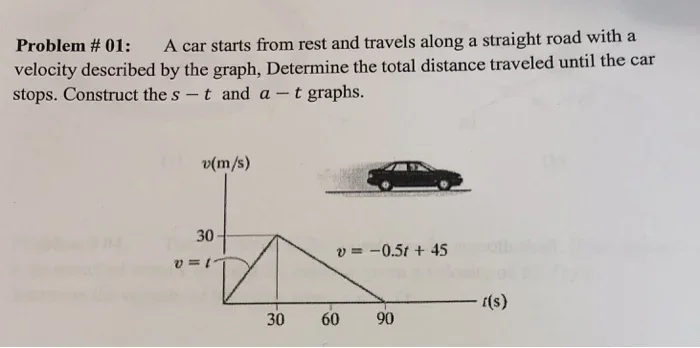
- Practice drawing velocity-time graphs — a straight sloped line means uniform acceleration
- The slope of a velocity-time graph gives you the acceleration value
- The area under a velocity-time graph gives you the distance traveled
- Use real-life scenarios like merging onto a highway to visualize the concept
- Watch videos of drag races to see uniform acceleration in action
Key Takeaways
- A car starting from rest means initial velocity is zero: this simplifies all kinematic equations and makes calculations much easier.
- Uniform acceleration means steady speed increase: the car gains equal velocity in equal time intervals, which is the foundation of motion physics.
- Three key formulas govern this type of motion: v = at, s = ½at², and v² = 2as are all you need to solve most problems.
- Real-world examples make the math tangible: from family sedans to sports cars and EVs, uniform acceleration applies to everyday driving situations.
- Avoiding common mistakes saves time and improves accuracy: watch your units, signs, and formula choices carefully.
- Engineers use these same principles daily: from vehicle design to crash testing, uniform acceleration is a practical tool in the automotive world.
- Practice builds confidence: the more problems you solve, the more natural acceleration calculation becomes.
Conclusion
A car starts from rest and accelerates uniformly is one of the most fundamental topics in physics and automotive science. It gives you the tools to understand how vehicles gain speed, how far they travel while doing so, and how to predict their behavior on the road. The kinematic equations we covered are simple, powerful, and widely applicable.
Whether you are a student working on homework, a driver curious about your car’s performance, or an aspiring engineer, mastering this concept opens doors. The formulas for final velocity, displacement, and acceleration calculation form the building blocks of force and motion analysis.
The best way to get better is to practice. Grab a pencil, pick some numbers, and work through a few problems. Draw velocity-time graphs. Check your answers against real-world scenarios. Over time, uniform acceleration will feel second nature to you. Keep learning, keep practicing, and enjoy the journey of understanding how motion works.
Frequently Asked Questions
What does it mean when a car starts from rest and accelerates uniformly?
It means the car begins at a complete stop with zero initial velocity and gains speed at a constant, steady rate. The acceleration value does not change over time, making the math straightforward to solve.
What is the formula for a car starting from rest with uniform acceleration?
The three main formulas are v = at for final velocity, s = ½at² for distance traveled, and v² = 2as for the relationship between velocity and displacement. Since the initial velocity is zero, these formulas become simpler versions of the standard kinematic equations.
How is uniform acceleration different from regular acceleration?
Regular or non-uniform acceleration means the rate of speed change varies over time. Uniform acceleration means the car gains the same amount of speed every second. This steady rate of change is what makes the calculations predictable and easy.
Can you give a real-life example of uniform acceleration in a car?
Yes. When a driver presses the gas pedal at a steady pressure on an open road, the car often experiences near-uniform acceleration. A sports car launching from a standstill or an electric vehicle pulling away smoothly are great everyday examples of car acceleration.
Why is initial velocity zero when a car starts from rest?
Starting from rest means the car is completely stationary before it begins moving. Velocity measures speed in a given direction, and a stationary car has zero speed. This is why the initial velocity equals zero in all uniform acceleration problems involving a car at rest.
How do velocity-time graphs represent uniform acceleration?
A velocity-time graph for uniform acceleration is a straight line with a positive slope. The slope of that line equals the acceleration value. The area under the line represents the total displacement or distance the car has traveled during the time interval.
=== QUICK SUMMARY ===
When a car starts from rest and accelerates uniformly, it begins at zero velocity and gains speed at a constant rate. This guide covers the three essential kinematic equations, step-by-step problem-solving methods, real-world examples, and common mistakes to avoid. You will learn how to calculate final velocity, displacement, and acceleration with confidence for any uniform acceleration scenario.
=== KEY TAKEAWAYS ===
Key Takeaways
- A car starting from rest means initial velocity is zero: this simplifies all kinematic equations and makes calculations much easier.
- Uniform acceleration means steady speed increase: the car gains equal velocity in equal time intervals, which is the foundation of motion physics.
- Three key formulas govern this type of motion: v = at, s = ½at², and v² = 2as are all you need to solve most problems.
- Real-world examples make the math tangible: from family sedans to sports cars and EVs, uniform acceleration applies to everyday driving situations.
- Avoiding common mistakes saves time and improves accuracy: watch your units, signs, and formula choices carefully.
- Engineers use these same principles daily: from vehicle design to crash testing, uniform acceleration is a practical tool in the automotive world.
- Practice builds confidence: the more problems you solve, the more natural acceleration calculation becomes.