How a Car Accelerates Uniformly from 18 Km Made Easy
When a car accelerates uniformly from 18 km, it gains speed at a steady, predictable rate. This guide breaks down the physics, formulas, and real-world applications of uniform acceleration in simple, easy-to-understand language. You will learn how to solve problems, avoid common mistakes, and apply kinematic equations like a pro.
When a car accelerates uniformly from 18 km, something fascinating happens. The vehicle gains speed at a perfectly steady rate. No jerking. No sudden bursts. Just smooth, predictable motion. This concept sits at the heart of motion physics and vehicle dynamics. Whether you are a student preparing for an exam or a car enthusiast curious about how vehicles perform, understanding uniform acceleration opens up a world of knowledge.
In this guide, we walk through everything you need to know. We explain the physics in plain language. We share easy-to-follow formulas. We work through real examples step by step. By the time you finish reading, you will feel confident solving any problem that involves a car accelerating uniformly from 18 km. Let us dive in.
Key Takeaways
- Uniform acceleration means constant speed gain: A car accelerates uniformly from 18 km when its velocity increases by equal amounts every second.
- Three key formulas solve every problem: The first, second, and third kinematic equations cover final velocity, distance, and time calculations.
- Unit conversion is essential: Always convert km/h to m/s before plugging values into acceleration formulas for accurate results.
- Real-world applications are everywhere: From highway merging to car performance tests, uniform acceleration models help engineers and drivers understand vehicle behavior.
- Common mistakes slow you down: Unit errors, confusing speed with velocity, and forgetting initial velocity are the top pitfalls to avoid.
- Practice makes perfect: Working through multiple examples builds confidence and deepens your understanding of motion physics.
📑 Table of Contents
- What Does It Mean When a Car Accelerates Uniformly from 18 Km?
- The Physics Behind Uniform Acceleration
- Essential Formulas and Unit Conversions
- Step-by-Step Problem Solving
- Real-World Examples and Vehicle Comparisons
- Common Mistakes and How to Avoid Them
- Expert Tips for Mastering Uniform Acceleration Problems
- Conclusion
What Does It Mean When a Car Accelerates Uniformly from 18 Km?
Let us start with the basics. When we say a car accelerates uniformly from 18 km, we mean the car starts at a speed of 18 kilometers per hour and then speeds up at a constant rate. The word “uniformly” is the key here. It tells us the acceleration rate does not change. Every second, the car gains the same amount of speed.
Think of it like walking up a ramp. The slope never changes. Your pace stays steady. That is what uniform acceleration feels like inside a car. The speedometer reading climbs smoothly. There are no sudden jumps or drops.
This scenario matters because it simplifies calculations enormously. When acceleration stays constant, we can use a set of reliable kinematic equations to predict exactly where the car will be and how fast it will go. These equations form the backbone of classical motion physics.
Why 18 Km/h Matters as an Initial Velocity
The number 18 km/h is our initial velocity. In physics terms, this is the speed the car has at the very start of our observation. We call this “u” in most formulas. Converting 18 km/h to meters per second gives us 5 m/s. This conversion is critical because the standard acceleration formula uses meters and seconds, not kilometers and hours.
Many students skip this step and make errors. Always convert your initial velocity before starting any calculation. It saves time and prevents mistakes. A car moving at 18 km/h is moving at a walking pace. It is a common speed in city driving, making this a very practical scenario to study.
The Physics Behind Uniform Acceleration
Understanding the science behind uniform acceleration makes everything click. It is not just about memorizing formulas. It is about understanding what is happening to the car physically.
The Definition of Uniform Acceleration
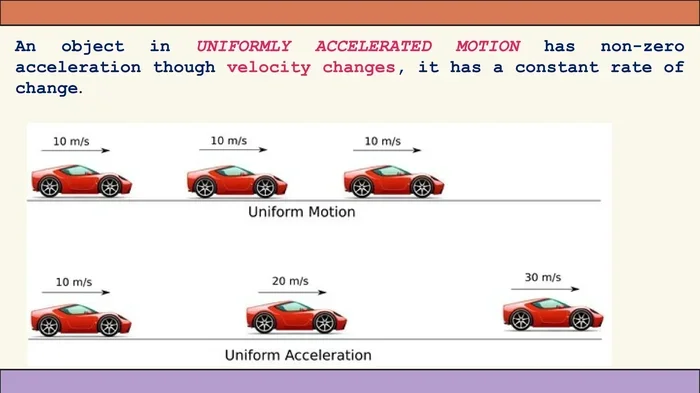
Uniform acceleration means the velocity changes by the same amount in every equal time interval. If a car gains 2 meters per second every second, that is uniform acceleration. The acceleration rate stays the same throughout the entire motion.
This is different from non-uniform acceleration, where the speed changes unevenly. Think of a car merging onto a highway with unpredictable bursts of power. That is non-uniform. But a car cruising on a straight road with cruise control adjusting throttle smoothly? That is closer to uniform acceleration.
Key Variables You Need to Know
Every acceleration calculation involves a few key variables. Let us break them down:
- Initial velocity (u): The speed at the start. For us, this is 18 km/h or 5 m/s.
- Final velocity (v): The speed at the end of the time period we are studying.
- Acceleration (a): How quickly the speed changes per second, measured in meters per second squared.
- Time taken (t): How long the acceleration lasts, measured in seconds.
- Distance traveled (s): How far the car moves during the acceleration phase.
These five variables are connected through kinematic equations. If you know any three of them, you can find the other two. That is the beauty of uniformly accelerated motion.
How Newton’s Laws Connect to This Scenario
Newton’s laws of motion provide the foundation for why uniform acceleration happens. Newton’s second law states that force equals mass times acceleration. When a car engine applies a constant force to the wheels, and resistive forces like friction and air resistance stay roughly the same, the net force remains constant. A constant net force means constant acceleration. That is exactly the scenario when a car accelerates uniformly from 18 km.
This connection between forces and motion is what makes vehicle dynamics such a rich and interesting field. The same principles that govern a toy car on a ramp also govern a real vehicle on a highway.
Essential Formulas and Unit Conversions
Now let us get to the tools you need. The three main kinematic equations will solve almost any problem involving a car accelerating uniformly from 18 km. But first, we must talk about unit conversion.
Converting km/h to m/s
The standard unit for speed in physics is meters per second (m/s). The standard unit for acceleration is meters per second squared (m/s²). So before you use any formula, convert your starting speed.
To convert km/h to m/s, divide by 3.6. That is it.
- 18 km/h ÷ 3.6 = 5 m/s
So our initial velocity is 5 m/s. This simple step is the foundation of every calculation that follows. Skipping it is the most common mistake students make.
The Three Main Kinematic Equations
Here are the three equations you need. Each one is missing a different variable, so you pick the one that fits your problem.
- Equation 1: v = u + at (relates final velocity, initial velocity, acceleration, and time)
- Equation 2: s = ut + ½at² (relates distance, initial velocity, acceleration, and time)
- Equation 3: v² = u² + 2as (relates final velocity, initial velocity, acceleration, and distance)
Each equation is a powerful tool. Together, they let you solve for any unknown in a uniformly accelerated motion problem. Let us see how they work in practice.
Step-by-Step Problem Solving
Nothing builds confidence like working through real examples. Let us solve three problems where a car accelerates uniformly from 18 km. Each example uses a different formula.
Example 1: Finding Final Velocity
A car starts at 18 km/h and accelerates at 3 m/s² for 10 seconds. What is its final velocity?
First, convert the initial velocity: 18 km/h = 5 m/s. Now use Equation 1:
v = u + at
v = 5 + (3 × 10)
v = 5 + 30
v = 35 m/s
Convert back to km/h if needed: 35 × 3.6 = 126 km/h. The car reaches 126 km/h after 10 seconds of steady acceleration.
Example 2: Calculating Distance Traveled
Using the same car, how far does it travel during those 10 seconds?
Use Equation 2:
s = ut + ½at²
s = (5 × 10) + ½(3 × 10²)
s = 50 + ½(300)
s = 50 + 150
s = 200 meters
The car covers 200 meters while accelerating from 18 km/h. That is about two football fields. Quite a distance for a smooth speed increase.
Example 3: Determining Time Taken
How long does it take for the car to reach 25 m/s from 18 km/h at 3 m/s² acceleration?
Use Equation 1 again:
v = u + at
25 = 5 + 3t
20 = 3t
t = 6.67 seconds
Just under seven seconds to reach that speed. These examples show how straightforward acceleration calculations become once you know the right formula.
Real-World Examples and Vehicle Comparisons
Uniform acceleration is not just a textbook concept. It shows up in real driving situations every day. Let us explore some practical scenarios.
Highway Merging Scenarios
When you merge onto a highway from an on-ramp, you often start at city speeds and accelerate to match traffic flow. If you press the gas pedal steadily, your car undergoes something close to uniform acceleration. Starting from around 18 km/h in a busy intersection and reaching highway speeds is a perfect real-world example.
Car Performance Tests
Automakers test vehicles on controlled tracks where conditions stay consistent. These road test environments aim for constant acceleration so they can compare different models fairly. The data from these tests helps engineers improve vehicle dynamics and engine performance.
Comparing Different Vehicles
Different cars accelerate at different rates. A small economy car and a powerful sports SUV will behave very differently even when starting from the same initial velocity of 18 km/h. Let us compare a few scenarios:
| Vehicle Type | Acceleration (m/s²) | Time to Reach 100 km/h from 18 km/h | Distance Covered |
|---|---|---|---|
| Small Economy Car | 2 m/s² | 12.5 seconds | 203 meters |
| Mid-Size Sedan | 3 m/s² | 8.3 seconds | 174 meters |
| Sports SUV | 4 m/s² | 6.3 seconds | 151 meters |
| Electric Sports Car | 6 m/s² | 4.2 seconds | 128 meters |
As you can see, the acceleration rate dramatically affects both the time and distance needed. Electric sports cars, with their instant torque, achieve uniform acceleration from 18 km/h faster than almost any other vehicle type.
Quick Tips for Reading Acceleration Data
- Always check whether the acceleration value is in m/s² or km/h per second.
- Compare vehicles over the same time period for a fair assessment.
- Remember that real-world acceleration is rarely perfectly uniform due to gear changes and varying road conditions.
- Use the distance traveled metric to understand how quickly a car gains ground, not just how fast it goes.
Common Mistakes and How to Avoid Them
Even experienced students make errors when solving uniform acceleration problems. Here are the most common mistakes and how to steer clear of them.
Unit Conversion Errors
This is the number one mistake. Mixing km/h with m/s in the same equation gives you a completely wrong answer. Always convert 18 km/h to 5 m/s before you start. Double-check every unit before plugging numbers into any acceleration formula.
Confusing Speed and Velocity
Speed is how fast something moves. Velocity is speed in a specific direction. In uniform acceleration problems, we usually assume straight-line motion, so the difference matters less. But in more advanced motion physics, direction becomes critical. Always ask yourself: is the car moving in a straight line?
Forgetting the Initial Velocity
When a car starts from 18 km/h, that is not zero. Some students accidentally set u = 0 and get incorrect results. The initial velocity of 5 m/s must be included in every relevant equation. This is especially important for Equation 2, where the distance depends directly on the starting speed.
Using Average Speed Instead of Instantaneous Values
Average speed is total distance divided by total time. But in uniform acceleration, the speed is changing constantly. Using average speed in the wrong formula leads to errors. Stick to the kinematic equations for accuracy.
Expert Tips for Mastering Uniform Acceleration Problems
Getting good at these problems takes practice, but a few expert strategies can speed up your learning significantly.
Draw a Diagram First
Before writing any numbers, sketch the situation. Draw a straight line representing the road. Mark the starting point with the car at 18 km/h. Show the direction of motion with an arrow. Label the final point, the acceleration rate, and the time. A simple diagram helps you visualize which variables go where.
Write Down What You Know
List your known variables before choosing a formula. For example:
- u = 5 m/s
- a = 3 m/s²
- t = 10 s
- v = ?
Seeing your known values organized makes it much easier to pick the right kinematic equation. This simple habit saves time and reduces errors.
Practice with Real Numbers
Use actual car specifications to make practice more engaging. Look up the acceleration stats of your favorite vehicle and work through problems using real data. This connects theory with practical application and makes the learning stick.
Check Your Answer with Common Sense
After solving a problem, ask yourself: does this answer make sense? If you calculate that a car reaches 500 km/h in three seconds from 18 km/h, something went wrong. Use rough estimates to verify your acceleration calculation before finalizing your answer.
Study the Patterns
Notice how the equations relate to each other. Equation 1 does not include distance. Equation 2 does not include final velocity squared. Equation 3 does not include time. Recognizing these patterns helps you quickly select the right tool for each problem. Over time, solving uniformly accelerated motion problems becomes second nature.
Conclusion
Understanding how a car accelerates uniformly from 18 km is more than a classroom exercise. It is a fundamental skill that connects physics to real life. From highway merging to car performance testing, uniform acceleration shapes how we experience driving every day.
We covered the core concepts, the essential formulas, and practical problem-solving techniques. We explored real-world examples and highlighted common mistakes to avoid. With the three kinematic equations in your toolkit and a solid understanding of constant acceleration, you are well-equipped to tackle any problem in this area.
The key is practice. Work through different scenarios. Convert units carefully. Draw diagrams. Check your answers. Each problem you solve builds your confidence and deepens your grasp of motion physics. So grab a pencil, pick a starting speed, and start solving. The road to mastering uniform acceleration starts right here.
Remember: a car accelerates uniformly from 18 km at a steady, predictable pace. Understanding that pace gives you power over the physics of motion. Use these tools, stay curious, and keep learning.
Frequently Asked Questions
What does uniform acceleration mean in simple terms?
Uniform acceleration means the speed changes by the same amount every second. When a car accelerates uniformly from 18 km, it gains speed steadily without any sudden jumps or slowdowns. The acceleration rate stays constant throughout the entire motion.
How do you convert 18 km/h to meters per second?
Divide the speed by 3.6. So 18 km/h ÷ 3.6 = 5 m/s. This conversion is essential before using any acceleration formula because the standard units in physics are meters and seconds.
What is the formula for final velocity in uniform acceleration?
The formula is v = u + at, where v is final velocity, u is initial velocity, a is acceleration, and t is time. This is the most commonly used kinematic equation for problems involving a car accelerating uniformly from 18 km.
Can a car really accelerate uniformly on real roads?
True uniform acceleration is an idealized model. In real life, factors like gear changes, wind resistance, and road incline cause slight variations. However, many road test scenarios and smooth highway driving situations closely approximate constant acceleration.
How long does it take to reach 100 km/h from 18 km/h?
It depends on the acceleration rate. At 3 m/s², it takes about 8.3 seconds. At 2 m/s², it takes about 12.5 seconds. The distance traveled and time taken vary based on the vehicle’s power and the acceleration rate.
What is the difference between speed and velocity in acceleration problems?
Speed is a scalar quantity that tells you how fast something moves. Velocity is a vector quantity that includes both speed and direction. In most uniform acceleration problems involving straight-line motion, we treat them as the same. But in advanced motion physics, direction matters and velocity is the correct term to use.