Why a car moving with constant speed turning around a curve
A car moving with constant speed turning around a curve still accelerates because its direction keeps changing. This change in direction creates centripetal force, which pulls the car toward the center of the curve. Without enough friction or proper road banking, the car can slide off the road. Understanding this physics helps drivers take curves safely and avoid accidents. Read on to learn exactly what happens and how to stay safe.
You are driving down a road. You keep your foot steady on the gas. Your speedometer reads the same number. Then the road curves ahead. You turn the steering wheel. The car follows the bend. Everything feels smooth. But something interesting is happening. Your car is accelerating even though the speed never changed.
This might sound confusing. How can something accelerate if it keeps the same speed? The answer lies in direction. When a car moves with constant speed turning around a curve, it is always changing direction. And any change in direction means acceleration. This concept is one of the most important ideas in basic physics and driving safety.
Understanding why a car moving with constant speed turning around a curve behaves the way it does can make you a better driver. It can also help you avoid accidents. In this article, we will break down the science in simple terms. We will look at the forces at play. We will explore how friction and road design help cars corner safely. And we will share practical tips you can use every time you drive.
Key Takeaways
- Constant speed does not mean no acceleration: A car moving with constant speed turning around a curve is constantly accelerating because its direction changes.
- Centripetal force is essential: This inward force keeps the car on its curved path and prevents it from flying off in a straight line.
- Friction between tires and road is critical: Without sufficient grip, the car will slide outward during a turn.
- Road banking helps cars corner safely: Banked curves use gravity and normal force to assist with turning.
- Speed and curve radius matter: Taking a curve too fast or on a tight radius increases the risk of losing control.
- Driver behavior affects safety: Braking mid-turn, overcorrecting, or ignoring road conditions can lead to dangerous situations.
📑 Table of Contents
What Happens When a Car Turns at Constant Speed
Let us start with the basics. When a car travels in a straight line at a steady speed, everything feels normal. There is no change in speed or direction. The car is in uniform motion. Now imagine the car enters a curve.
Even if the driver does not press the gas pedal harder, the car is no longer in uniform motion. Why? Because the direction of travel is changing. Physics defines acceleration as any change in velocity. Velocity is speed plus direction. So when direction changes, velocity changes. And when velocity changes, there is acceleration.
This type of acceleration is called centripetal acceleration. It always points toward the center of the curve. Think of it like this. If you swing a ball on a string, the ball wants to fly outward. The string pulls it inward. That inward pull is centripetal force. The same idea applies to your car.
The Role of Direction Change in Acceleration
Many drivers think acceleration only means going faster. That is a common mistake. Acceleration also means changing direction. A car going around a curve at 30 mph is accelerating the entire time. The speedometer might not move at all. But the car is still accelerating because its path is curving.
This is why taking a curve feels different from driving straight. Your body wants to keep moving forward in a straight line. But the car is being pulled toward the center of the curve. This tug creates the sensation of being pushed outward. In reality, your body is just trying to keep going straight while the car turns.
The Science Behind Centripetal Force
Now let us talk about the force that makes turning possible. Every time a car moves with constant speed turning around a curve, a specific force acts on it. That force is centripetal force. Without it, the car would fly off the road in a straight line.
Centripetal force is not a new or mysterious force. It is simply the net force that keeps an object moving in a circle. In the case of a car, several real forces work together to create centripetal force. Let us look at each one.
How Friction Creates the Turning Force
The most important force in any turn is friction. Friction is the grip between your tires and the road surface. When you turn the steering wheel, the tires change their angle. They push against the road sideways. The road pushes back. This push and pull creates the centripetal force needed to follow the curve.
Here is a simple way to think about it. Imagine driving on a perfectly icy road. The tires have almost no grip. You turn the steering wheel. Nothing happens. The car keeps going straight. Why? Because there is no friction to create the centripetal force. The car cannot follow the curve.
This is why road conditions matter so much. Wet roads, gravel, or ice all reduce friction. They reduce the grip your tires have. When grip is low, centripetal force is low. And when centripetal force is low, the car cannot safely navigate the curve.
The Formula for Centripetal Force
For those who like the math, centripetal force follows a simple formula. It equals mass times velocity squared, divided by the radius of the curve. In plain language:
- Heavier cars need more centripetal force to turn.
- Higher speeds require much more force. Doubling speed quadruples the needed force.
- Tighter curves (smaller radius) need more force than gentle curves.
This formula explains why sharp turns at high speed are so dangerous. The force required goes up fast. If the tires cannot provide enough grip, the car slides.
Why Speed and Turning Are Always Connected
Even though we are talking about constant speed, the actual speed chosen for a turn matters a great deal. A car moving with constant speed turning around a curve at 15 mph behaves very differently than the same car taking the same curve at 50 mph.
At higher speeds, the centripetal force needed is much greater. The tires must grip harder. The driver must steer more carefully. And the risk of losing control increases significantly.
Safe Cornering Speed Depends on Several Factors
There is no single safe speed for every curve. The right speed depends on multiple factors:
- Radius of the curve: Tight curves need lower speeds than wide ones.
- Road surface: Dry asphalt offers more grip than wet or icy roads.
- Tire condition: Worn tires have less grip than new ones.
- Vehicle weight: Heavier vehicles need more force to change direction.
- Road banking: Banked curves can handle higher speeds more safely.
Experienced drivers adjust their speed before entering a curve. They slow down while the road is still straight. Then they coast through the turn at a steady pace. This approach keeps the tires in the best position to provide centripetal force.
The Dangers of Braking During a Turn
One of the most common mistakes drivers make is braking while in a curve. When you brake mid-turn, you reduce the tire grip available for centripetal force. The tires now have to handle both slowing down and turning at the same time. This can overwhelm the available friction.
The result can be a understeer or oversteer situation. Understeer happens when the front tires lose grip. The car keeps going straight instead of following the curve. Oversteer happens when the rear tires lose grip. The back of the car swings outward. Both situations are dangerous.
The best practice is simple. Slow down before the curve. Release the brake. Then steer smoothly through the turn. This gives your tires the best chance to maintain grip.
How Friction Keeps Your Car on the Road
Friction is the unsung hero of every turn you make. Without it, cars could not follow curved roads at all. Let us look more closely at how friction works during a curve.
When your car moves with constant speed turning around a curve, the tires are not rolling straight anymore. They are being forced to change direction. The contact patch of each tire pushes laterally against the road. Static friction between the rubber and the pavement resists this lateral push. That resistance is what keeps the car on its curved path.
Static vs. Kinetic Friction in Turning
There are two types of friction to understand here. Static friction acts when the tires are gripping the road without sliding. Kinetic friction acts when the tires are sliding. Static friction is stronger than kinetic friction.
This means that as long as your tires are gripping and not sliding, you have the maximum available force for turning. Once the tires start to slide, the force drops. The car begins to drift. This is why maintaining grip is so important.
Tire quality matters a lot here. All-season tires, summer tires, and winter tires all have different grip levels. Worn tires lose their ability to maintain static friction. Even with new tires, driving too fast for a curve can push the tires past their grip limit.
Tips to Maximize Tire Grip
- Check your tire pressure regularly. Underinflated tires reduce grip.
- Replace tires when the tread wears down below safe levels.
- Match your tires to the season and road conditions.
- Avoid sudden steering inputs, which can break tire grip.
- Keep your tires properly aligned and balanced.
Road Banking and How It Helps Cars Corner
Have you ever noticed that some curves are tilted? The outside edge of the road is higher than the inside edge. This is called road banking or a banked curve. It is an engineering solution that makes turning safer.
On a flat road, all the centripetal force must come from tire friction alone. On a banked curve, the road itself helps push the car toward the center of the curve. The normal force from the road surface has a horizontal component that adds to the centripetal force.
Why Banked Curves Are Safer
Banked curves reduce the reliance on friction. This means cars can take the curve safely even when the road is wet or icy. The banking angle is designed for a specific speed range. Highways often have steeply banked curves for fast-moving traffic. Residential streets usually have gentle or no banking.
The physics of a banked curve is elegant. Gravity pulls the car downward. The road pushes back upward at an angle. The combination of these two forces creates a net force pointing toward the center of the curve. This helps the car follow the bend without needing as much tire grip.
What Happens on Unbanked Curves
On an unbanked curve, friction is the only source of centripetal force. This puts more pressure on the tires. If friction is reduced by rain, leaves, or ice, the car can easily slide off the road. Drivers must slow down more on unbanked curves, especially in bad weather.
Understanding road banking helps you read the road ahead. When you see a banked curve, you know the engineers designed it for a certain speed. But it is always wise to adjust for current conditions. Even a banked curve can be slippery when wet.
Common Mistakes When Taking Curves
Even with a good understanding of the physics, drivers still make mistakes. Let us look at the most common errors and how to avoid them.
Mistake 1: Taking the Curve Too Fast
This is the number one cause of curve-related accidents. A car moving with constant speed turning around a curve at too high a speed needs more centripetal force than the tires can provide. The result is a skid or a spin. Always slow down before the curve, not during it.
Mistake 2: Overcorrecting When the Car Starts to Slide
If the car starts to slide, many drivers panic and jerk the steering wheel. This makes things worse. The correct response is to ease off the gas and steer gently in the direction you want to go. This helps the tires regain grip.
Mistake 3: Ignoring Road Conditions
A curve that is safe on a dry summer day can be very different on a rainy autumn evening. Leaves, oil, puddles, and frost all change the friction between tires and road. Adjust your speed and driving style to match current conditions.
Mistake 4: Not Looking Ahead
Good drivers look far ahead, not just at the car directly in front of them. When approaching a curve, look through the curve to where you want to end up. This helps you plan your speed and steering input before you enter the turn.
Real-World Examples and Practical Insights
Let us bring this all together with some real-world scenarios.
Scenario 1: The Highway Off-Ramp. You are exiting a highway. The off-ramp is a tight curve. Your speed is still high from the highway. Even though you do not press the brake, the car is accelerating because it is changing direction. If you are going too fast, the tires may not provide enough centripetal force. The car could push outward and leave the road.
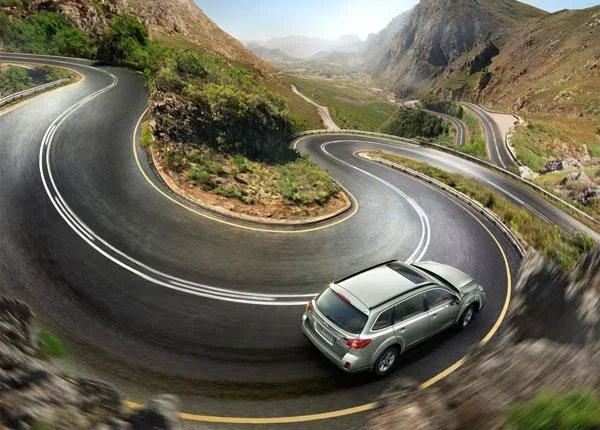
Scenario 2: The Mountain Switchback. You are driving on a mountain road with tight hairpin turns. The road is banked to help with the curve. But it is raining. The banking helps, but the wet road reduces friction. You need to slow down well below the dry-weather speed to stay safe.
Scenario 3: The Parking Lot Exit. Even low-speed curves need centripetal force. When you slowly turn out of a parking space, your car is still accelerating because its direction is changing. At low speeds, the force is small and the tires handle it easily. But the principle is the same.
Quick Tips for Safe Cornering
- Always slow down before the curve, never during it.
- Look through the curve to your exit point.
- Steer smoothly and avoid sudden movements.
- Increase your following distance on curvy roads.
- Be extra cautious on curves that are shaded or near water.
- Trust your tires but do not exceed their limits.
- Remember that a car moving with constant speed turning around a curve is still accelerating and needs centripetal force.
Conclusion
A car moving with constant speed turning around a curve is a perfect example of how physics shapes everyday driving. The car may not be speeding up or slowing down, but it is constantly changing direction. This change in direction means acceleration. And acceleration requires a force. That force is centripetal force, created mainly by the friction between your tires and the road.
Understanding this concept helps you become a safer driver. You now know why speed matters in curves. You understand why braking mid-turn is risky. You can appreciate how road banking and tire grip work together to keep you on the road. The next time you approach a curve, remember the physics at work. Slow down, steer smoothly, and trust your knowledge.
Safe driving is not just about following rules. It is about understanding why those rules exist. The science behind a car moving with constant speed turning around a curve is a great example of that truth. Use this knowledge every time you drive, and you will be better prepared for any curve the road throws at you.
Frequently Asked Questions
Why does a car moving with constant speed turning around a curve still accelerate?
Acceleration is not just about changing speed. It also means changing direction. When a car follows a curve, its direction is constantly changing. This change in direction is a form of acceleration called centripetal acceleration. So even if the speedometer never moves, the car is still accelerating.
What force keeps a car on its curved path?
The force that keeps a car on its curved path is called centripetal force. In most cases, this force comes from the friction between the tires and the road. The tires push sideways against the road, and the road pushes back, creating the inward force needed to follow the curve.
Can a car take a curve safely on ice even at low speed?
Even at low speed, a car needs some friction to generate centripetal force. On ice, friction is extremely low. This means the tires cannot grip the road enough to create the force needed to turn. The car will slide in a straight line regardless of how slowly you are moving.
How does road banking help cars turn?
Road banking tilts the road surface so that the normal force from the road has a horizontal component pointing toward the center of the curve. This horizontal component adds to the centripetal force. Banked curves reduce the reliance on tire friction alone, making turns safer especially in wet or icy conditions.
What should you do if your car starts to slide in a curve?
If your car starts to slide, ease off the gas pedal and steer gently in the direction you want to go. Do not brake hard or jerk the steering wheel. These actions can make the slide worse. Let the tires regain grip before making any further inputs.
Does the weight of a car affect how it handles curves?
Yes, heavier cars need more centripetal force to follow a curve. This is because centripetal force depends on mass. Heavier vehicles also have more momentum, which can make it harder to change direction. This is why trucks and SUVs often need to take curves at lower speeds than lighter cars.
=== END OF ARTICLE ===