Learn How to Check Tire Pressure on a 2021 Honda Civic
Checking tire pressure on your 2021 Honda Civic is simple, fast, and essential for safety, fuel economy, and tire longevity. This guide walks you through every step using a basic tire gauge, the recommended PSI for your Civic, and practical tips to avoid common mistakes. You will learn how to read your gauge, when to check, and how to maintain the right pressure all year round.
Your 2021 Honda Civic is a reliable, efficient car. But one simple thing can make or break its performance: tire pressure. Many drivers overlook this basic maintenance task until something goes wrong. A flat tire, poor fuel economy, or uneven tire wear can all trace back to one root cause. Wrong tire pressure.
In this guide, we will walk you through exactly how to check tire pressure on a 2021 Honda Civic. We will cover the recommended PSI, the tools you need, and the step-by-step process. By the end, you will feel confident doing this yourself in under five minutes. Let us get started.
Key Takeaways
- Proper tire pressure keeps you safe: Correct PSI reduces the risk of blowouts and improves handling on the road.
- Check tire pressure monthly: Tires lose about 1 PSI per month, so regular checks are a must.
- Use the recommended PSI for the 2021 Honda Civic: The sticker on the driver’s door lists the exact pressure your car needs.
- Check tires when they are cold: Driving heats up tires and gives false readings.
- A digital tire gauge is the most accurate tool: Skip the gas station air pumps and invest in a quality gauge.
- Underinflated and overinflated tires both cause problems: Both lead to uneven wear and reduced fuel economy.
📑 Table of Contents
- Why Tire Pressure Matters for Your 2021 Honda Civic
- Understanding the Recommended Tire Pressure for the 2021 Honda Civic
- Tools You Need to Check Tire Pressure
- Step-by-Step Guide to Checking Tire Pressure on a 2021 Honda Civic
- Common Tire Pressure Mistakes and How to Avoid Them
- Maintaining Proper Tire Pressure Long-Term
- Final Thoughts
Why Tire Pressure Matters for Your 2021 Honda Civic
Tire pressure is not just a number on a sticker. It directly affects how your car drives, how safe it is, and how much fuel you use. When your tires are not at the right pressure, several problems can follow.
Underinflated tires create more rolling resistance. This means your engine works harder. Your fuel economy drops. You fill up more often. Over time, underinflated tires also wear out on the outer edges of the tread. This means you replace tires sooner than you should.
Overinflated tires are just as problematic. They wear out in the center of the tread. They also give you a harsher ride. Your car may feel bouncy or less stable, especially on wet roads. Tire safety depends on getting this balance right.
Properly inflated tires also help with handling. Your 2021 Honda Civic was engineered with specific tire pressure in mind. When you follow those numbers, you get the best grip, the shortest stopping distances, and the smoothest ride. It is a small task with big rewards.
How Tire Pressure Affects Fuel Economy
Studies show that underinflated tires can reduce fuel efficiency by up to 3%. That might not sound like much. But over a year of driving, it adds up. You pay more at the pump for something you could have prevented. Keeping your tire pressure PSI at the recommended level is one of the easiest ways to save money on gas.
Some drivers wonder whether checking tire pressure also relates to other car systems. For example, if you notice warning lights or performance issues, it is worth checking related maintenance tasks too. For instance, checking your car battery regularly helps ensure your entire vehicle runs smoothly.
Understanding the Recommended Tire Pressure for the 2021 Honda Civic
Every car has a recommended tire pressure. For the 2021 Honda Civic, this number is easy to find. You do not need to guess or look it up online. The manufacturer put the information right on your car.
Where to Find the Recommended PSI
Open your driver’s door. Look at the frame on the side where the door latches. You will see a sticker or a small plaque. This sticker lists the recommended tire pressure for both the front and rear tires. For most 2021 Honda Civic models, the number falls between 32 and 35 PSI. However, always go by what your specific sticker says.
The sticker also tells you the tire size your Civic came with. This information is helpful when you need to buy replacement tires. Common tire sizes for the 2021 Civic include 205/55R16 and 215/45R17, depending on the trim level.
Cold Tire Pressure vs. Hot Tire Pressure
Here is something many drivers do not know. Tire pressure changes with temperature. When the air outside gets cold, the pressure inside your tires drops. When it gets hot, the pressure rises. This is why the sticker gives you the cold tire pressure number.
Cold tire pressure means the reading you get after the car has sat for at least three hours or driven less than a mile. If you check your tires right after a highway drive, the reading will be higher. This does not mean your tires are overinflated. It just means the air inside is warm and expanded.
Temperature changes also matter seasonally. In winter, tire pressure can drop 1 PSI for every 10-degree drop in outside temperature. In summer, the opposite happens. This is why checking your tire pressure monitoring system (TPMS) light and doing manual checks go hand in hand.
Weather extremes affect tire pressure in both directions. If you live in a hot climate, your tires may read high in summer. If you live somewhere cold, you may need to add air more frequently. Cold weather can also impact other aspects of your vehicle, so keeping up with seasonal maintenance is always smart.
Tools You Need to Check Tire Pressure
You do not need expensive tools to check your tire pressure. A few simple items are all you need. Here is what to gather before you start.
- A tire pressure gauge: This is the most important tool. You can get a digital gauge or a pencil-style gauge. Digital gauges are more accurate and easier to read. They cost between $10 and $25.
- An air compressor or access to an air pump: You can use a portable compressor, a gas station air pump, or a home compressor.
- The owner’s manual or the door sticker: Keep these handy so you know the exact PSI to aim for.
- A pen and paper or your phone: Write down each tire’s reading so you can track trends over time.
Digital vs. Analog Tire Gauges
Digital tire gauges give you a quick, precise reading. They are easy to read, even in low light. Many drivers prefer them because there is no guessing. Analog or pencil-style gauges work well too, but they can be less accurate over time. The small plastic sticks inside can wear down, leading to incorrect readings.
For the best results, invest in a quality digital tire gauge. It is a small investment that pays off in accuracy and convenience.
Do You Need a Professional Tire Pressure Service?
Some drivers wonder if they should pay a shop to check their tire pressure. The truth is, you can do it yourself. The process takes less than five minutes. You save time and money by learning this simple skill. However, if you notice your TPMS light stays on even after adjusting pressure, a professional can help diagnose deeper issues with your tire pressure reset system.
Step-by-Step Guide to Checking Tire Pressure on a 2021 Honda Civic
Now for the main part. Here is exactly how to check your tire pressure, step by step. Follow this process for all four tires, including the spare if applicable.
Step 1: Park Your Car in a Cool, Shaded Area
Start by parking your 2021 Honda Civic in a shaded area or a garage. Make sure the tires have cooled down. If you have been driving, wait at least 30 minutes. Parking in the shade also prevents the sun from heating the tires while you work. Direct sunlight can significantly heat up your car and tires, which skews your readings.
Step 2: Locate the Tire Valve Stem
Each tire has a valve stem. It is the small metal or rubber protrusion on the inside of the wheel. Remove the plastic cap from the valve stem. Set the cap aside in a safe place so you do not lose it.
Step 3: Press the Gauge Firmly onto the Valve Stem
Take your tire gauge and press it firmly onto the valve stem. You should hear a brief hiss of air. This is normal. Hold the gauge steady and straight. Wait for the reading to stabilize.
If you are using a digital gauge, the screen will display the PSI number within a second. If you are using a pencil-style gauge, a small rod will slide out with a number printed on it.
Step 4: Compare the Reading to the Recommended PSI
Look at the number on your gauge. Compare it to the recommended PSI listed on your door sticker. For example, if the sticker says 33 PSI and your gauge reads 29 PSI, your tire is underinflated by 4 PSI.
Here is a quick reference table for common scenarios:
- Reading matches the recommended PSI: Your tire is in great shape. Move to the next tire.
- Reading is below the recommended PSI: You need to add air. Use an air compressor or visit a gas station.
- Reading is above the recommended PSI: Let out a small amount of air by pressing the pin inside the valve stem. Check again.
Step 5: Add or Release Air as Needed
If your tire is low, attach the air hose to the valve stem. Add air in short bursts. Check the pressure after each burst. This prevents you from overinflating. If you add too much, press the valve pin to release a little air. Go slow and steady.
Step 6: Replace the Valve Cap
Once all four tires are at the correct pressure, put the valve caps back on. These caps keep dirt and moisture out of the valve stem. Skipping this step can lead to slow leaks over time.
Step 7: Record Your Readings
Write down the PSI for each tire. This helps you track patterns. If one tire consistently loses air, you may have a slow leak that needs attention.
Common Tire Pressure Mistakes and How to Avoid Them
Even experienced drivers make mistakes when checking tire pressure. Here are the most common ones and how to avoid them.
Checking Tires After Driving
This is the number one mistake. Hot tires give higher readings. You think everything is fine, but your tires are actually underinflated. Always check when the tires are cold for the most accurate result.
Relying Only on the TPMS Light
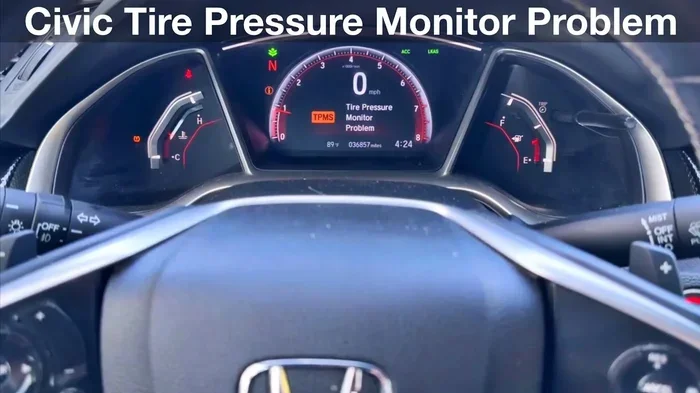
The tire pressure monitoring system in your 2021 Honda Civic is helpful. But it only alerts you when pressure drops significantly, usually 25% below the recommended level. By the time the light comes on, your tires are already dangerously low. Do not wait for the light. Check manually every month.
Guessing the PSI Instead of Checking the Sticker
Every car model is different. The recommended pressure for a 2021 Honda Civic is not the same as for other vehicles. Never guess. Always check the sticker on your door or your owner’s manual.
Ignoring the Spare Tire
Your spare tire also needs the correct pressure. Spare tires lose air over time too. A flat spare when you need it most is a frustrating situation. Make it a habit to check the spare during your monthly tire pressure routine.
Using the Gas Station Gauge Without Checking Its Accuracy
Gas station air pumps are often inaccurate. The gauges wear out and give wrong readings. If you rely on them, bring your own gauge to double-check. This simple habit saves you from overinflating or underinflating your tires.
Maintaining Proper Tire Pressure Long-Term
Checking tire pressure once is not enough. You need to make it a regular habit. Here is how to keep your 2021 Honda Civic tires in top shape all year long.
Set a Monthly Reminder
Mark your calendar or set a phone reminder to check tire pressure once a month. This takes only a few minutes and prevents most tire pressure problems before they start.
Check Before Long Trips
Before any road trip, check all four tires plus the spare. Long drives put more stress on your tires. Properly inflated tires handle the extra miles better and keep you safe on the highway.
Monitor for Slow Leaks
If you notice one tire consistently losing air, investigate. A nail, a faulty valve stem, or a poor seal between the rim and tire can cause slow leaks. Address these issues early to avoid a flat tire at an inconvenient moment.
Rotate Your Tires Regularly
Tire rotation helps your tires wear evenly. Most experts recommend rotating every 5,000 to 7,500 miles. Even with perfect pressure, tires wear at different rates depending on their position on the car. Rotation extends the life of your set.
Know When to Replace Your Tires
No matter how well you maintain tire pressure, tires wear out eventually. Check the tread depth regularly with a penny test. Insert a penny into the tread with Lincoln’s head facing down. If you can see the top of his head, your tread is too worn. It is time for new tires. Also, if you notice cracks, bulges, or frequent flats, replacement is the safest choice.
Tire pressure also connects to how much weight your car can safely carry. Overloading your vehicle puts extra stress on underinflated tires. To understand your Civic’s limits, you can refer to guidelines about how much weight a regular car can carry.
Final Thoughts
Checking tire pressure on your 2021 Honda Civic is one of the simplest and most impactful things you can do for your car. It takes less than five minutes, costs nothing, and protects your safety, your fuel economy, and your tires. Make it a monthly habit and your Civic will reward you with smooth rides, better mileage, and longer-lasting tires.
Do not wait for the TPMS light or a flat tire to remind you. Grab a tire gauge today. Check your pressure. And enjoy the peace of mind that comes with knowing your car is in great shape.
Frequently Asked Questions
How often should I check tire pressure on my 2021 Honda Civic?
You should check your tire pressure at least once a month. Tires naturally lose about 1 PSI per month. Also check before any long road trip. Cold weather months may require more frequent checks since low temperatures reduce tire pressure.
What is the recommended tire pressure for a 2021 Honda Civic?
The recommended PSI is listed on the sticker inside your driver’s door. For most 2021 Civic models, it falls between 32 and 35 PSI. Always go by your specific sticker rather than a general number, as different trims may vary slightly.
Can I check tire pressure with the TPMS light off?
Yes, you should check tire pressure regularly even if your TPMS light is off. The tire pressure monitoring system only alerts you when pressure drops 25% or more below the recommended level. Manual checks help you catch problems much earlier.
What happens if my tire pressure is too low?
Underinflated tires cause poor fuel economy, uneven tire wear on the outer edges, and reduced handling. In serious cases, they can lead to blowouts or flats. Low pressure also makes your tires overheat, which accelerates wear and increases the risk of failure.
Should I check tire pressure in the morning or evening?
Morning is ideal because your tires have had time to cool overnight. This gives you the most accurate cold tire pressure reading. Avoid checking right after driving, as the heat from the road and friction will raise the pressure temporarily.
Do I need to reset my TPMS after checking tire pressure?
In most cases, the TPMS light will reset on its own once you bring your tires to the correct pressure. If the light stays on, you may need to perform a tire pressure reset through your Civic’s infotainment system or consult your owner’s manual for specific reset steps.