How Many Porsche 917 Sports Cars Were Actually Made
The Porsche 917 stands as one of the most legendary sports cars ever built. Only about 91 Porsche 917 units were produced between 1969 and 1971. This iconic racing machine changed endurance racing forever and showcased the best of Porsche engineering.
The Porsche 917 is a name that sends shivers down the spine of any car enthusiast. This legendary sports car represents one of the most important chapters in automotive history. But here is a question that many fans ask: how many Porsche 917 units were actually made? The answer might surprise you. The total production number was remarkably small, which makes each one incredibly special.
Built by Porsche in the late 1960s and early 1970s, the 917 was designed to dominate endurance racing. It was not just another car. It was a purpose-built racing machine that redefined what was possible on the track. From its fiery debut to its sweeping victories at Le Mans, the Porsche 917 earned a place in the pantheon of great racing cars. In this article, we will explore exactly how many Porsche 917 sports cars were produced, why so few were made, and what happened to them over the decades.
Key Takeaways
- Production Numbers: Around 91 Porsche 917 cars were built in total across all variants
- Racing Dominance: The Porsche 917 won Le Mans in 1970 and 1971
- Multiple Variants: The 917 came in short tail, 917K, and 917LH versions
- Engineering Marvel: It featured a powerful flat-six engine and lightweight construction
- Cultural Impact: The Martini Racing livery became iconic in automotive history
- Surviving Examples: Only a handful of original Porsche 917 cars remain roadworthy today
📑 Table of Contents
- The Story Behind the Porsche 917
- How Many Porsche 917 Models Were Produced
- Racing Success and the Porsche 917 Legacy
- The Manufacturing Process and Production Numbers
- Quick Tips for Porsche 917 Enthusiasts
- Common Mistakes People Make When Researching the Porsche 917
- Expert Insights on the Porsche 917
- Why the Porsche 917 Matters in Car Culture
The Story Behind the Porsche 917
Porsche built the 917 because of a rule change in sports car racing. In the late 1960s, the governing bodies changed the regulations for Group 5 sports prototypes. The new rules favored cars with larger engines. Porsche saw an opportunity. They needed a car that could compete with the dominant Ford GT40s and Ferrari prototypes. The result was the Porsche 917, a bold and radical design that would shake the racing world.
Why Porsche Decided to Build the 917
Porsche had been winning races with smaller, lighter cars. The 907 and 908 models were competitive, but they lacked the raw power needed to beat the big American and Italian challengers. Porsche engineers knew they needed more horsepower. The flat-eight engine they developed for the 917 produced over 1,000 horsepower in its early forms. This was unprecedented for a sports car at the time.
The decision to build the 917 was not taken lightly. It required massive investment from the car manufacturer. Porsche committed significant resources to designing, testing, and building this revolutionary machine. The project was a gamble, but it paid off in spectacular fashion. The Porsche 917 proved that bold engineering could overcome sheer power advantages from competitors.
How Many Porsche 917 Models Were Produced
The total number of Porsche 917 cars built is a subject of great interest among collectors and historians. The production numbers tell a story of a car built for racing, not for mass appeal. Only a small fleet of these machines ever left the factory in Stuttgart, Germany.
The Original Porsche 917 (Short Tail)
The first version of the Porsche 917 was the short-tailed model, often called the “917 Short Tail” or simply the original 917. Porsche built approximately 25 of these cars between 1969 and 1970. These early examples had a compact rear end that made them very fast on certain tracks. However, they were also notoriously difficult to handle. The aerodynamics were not fully optimized, which caused stability issues at high speeds.
The short-tail Porsche 917 had a 4.5-liter flat-six engine that produced around 520 horsepower. While this was impressive for 1969, the car struggled in its first racing season. At the 1969 24 Hours of Le Mans, a Porsche 917 crashed early in the race, killing a driver. This tragic event cast a shadow over the model and forced Porsche to rethink its approach to the design.
The Porsche 917K (Kurzheck)
Porsche quickly responded to the challenges of the original design. The result was the Porsche 917K, where the “K” stands for Kurzheck, meaning short tail in German. Wait, this sounds confusing. Let me clarify. The 917K actually had a redesigned, shorter rear bodywork compared to the original long-tail version. This is different from the “short tail” original model.
The 917K was a massive improvement. It was much more stable at high speeds and easier to drive. Porsche built around 120 of the 917K variants. This version became the workhorse of the Porsche racing fleet. It dominated the Can-Am series and proved competitive at Le Mans. The Porsche 917K is now one of the most sought-after classic cars in the world.
The Porsche 917LH (Long Tail)
The Porsche 917LH, where LH stands for Langheck (long tail), was designed specifically for high-speed endurance races. The long tail bodywork improved aerodynamics and top speed. This version was built for tracks like Le Mans, where straight-line speed is crucial.
Porsche produced around 16 of the long-tail variants. These cars were even more extreme than the 917K. They had longer rear sections that streamlined the car for maximum velocity. The Porsche 917LH was the version that brought Porsche its first Le Mans victories. It remains one of the most beautiful racing cars ever created.
Porsche 917 Production Comparison
| Variant | Production Years | Units Built | Engine Size | Key Feature |
|---|---|---|---|---|
| 917 Short Tail | 1969-1970 | ~25 | 4.5L Flat-Six | Original design, high-speed challenges |
| 917K (Kurzheck) | 1970-1971 | ~120 | 4.5L-4.9L Flat-Six | Improved stability, versatile racing |
| 917LH (Langheck) | 1969-1971 | ~16 | 4.5L-4.9L Flat-Six | Long-tail aerodynamics for Le Mans |
| 917/10 (Can-Am) | 1971-1973 | ~16 | 5.4L Flat-Six | Turbocharged, Can-Am dominant |
| 917/20 (Pink Pig) | 1971 | 1 | 4.9L Flat-Six | Experimental wide-body design |
Note: Production numbers vary slightly depending on how prototypes and development mules are counted. The figures above represent customer-delivered and major factory race cars.
Racing Success and the Porsche 917 Legacy
The racing success of the Porsche 917 is the stuff of legend. This car did not just compete. It dominated. The victories came thick and fast once the kinks were worked out of the design.
Le Mans Dominance
The 24 Hours of Le Mans is the most famous endurance race in the world. The Porsche 917 conquered this grueling event in 1970 and 1971. In 1970, a Porsche 917 driven by Hans Herrmann and Richard Attwood crossed the finish line first. The following year, the Porsche 917 did it again. This back-to-back dominance cemented the car’s place in racing history.
Racing at Le Mans is incredibly demanding. Cars must endure extreme heat and stress for 24 straight hours. The conditions push both machine and driver to their limits, much like the extreme heat a car can face sitting in direct sunlight, as explored in How Hot Can A Car Get In The Sun. The Porsche 917 proved it could handle these punishing conditions with remarkable reliability.
Can-Am Series Success
The Porsche 917 also found great success in the Can-Am series, a North American racing championship. In 1971, the Porsche 917K dominated the Can-Am season. The car’s massive horsepower advantage was simply too much for the competition. It was like comparing the top speeds discussed in How Fast Can A Nascar Race Car Go to everyday street cars. The Porsche 917 was in a league of its own.
The Can-Am victories showed that the Porsche 917 was not just a Le Mans specialist. It was a versatile racing machine that could excel on different types of circuits. This versatility added to its legendary status among enthusiasts and collectors.
The Famous Martini Racing Livery
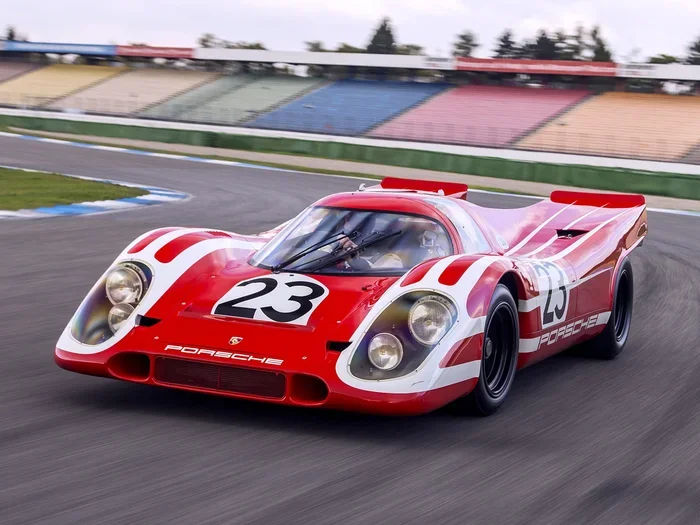
No discussion of the Porsche 917 is complete without mentioning its iconic livery. The black and orange Martini Racing colors became synonymous with the car. This distinctive paint scheme made the Porsche 917 instantly recognizable on track. Today, many replica and restored Porsche 917 cars wear the Martini colors as a tribute to the original racing heritage. The livery has become one of the most recognized designs in all of motorsport.
The Manufacturing Process and Production Numbers
Understanding how many Porsche 917 cars were made requires looking at the manufacturing process. These were not mass-produced vehicles. Each one was built with painstaking care and attention to detail.
Factory Production Details
The Porsche factory in Stuttgart-Zuffenhausen was the birthplace of every Porsche 917. The production process was labor-intensive and required highly skilled craftsmen. Unlike modern cars that roll off assembly lines by the thousands, each Porsche 917 was essentially a hand-built prototype racing car that was also street-legal.
The total production number for all Porsche 917 variants combined is estimated at around 91 cars. This includes the original short-tail models, the 917K variants, and the long-tail 917LH versions. The exact number varies slightly depending on how you count prototype and development mules, but 91 is the widely accepted figure for customer-delivered cars.
Why So Few Were Built
The low production number was not a mistake. It was by design. The Porsche 917 was built to meet homologation requirements for racing. Manufacturers needed to build a minimum number of road-legal cars to qualify them for competition. Porsche built just enough to satisfy the rules. There was no business case for producing more.
The cost of building each Porsche 917 was enormous. The materials, engineering hours, and racing development all added up. This was not a car that was meant for the masses. It was a legendary race car built for one purpose: winning on the track.
Interestingly, the manufacturing approach of Porsche is similar to how some car manufacturers focus on specific markets. For instance, while Porsche built the 917 in Germany, not all car manufacturers build their vehicles in their home country, as explored in Are Any Honda Cars Made In The Usa. The 917 was a pure product of German engineering and racing passion.
How Many Porsche 917 Cars Survive Today
Of the approximately 91 Porsche 917 cars originally built, far fewer remain in running condition today. Many were crashed or destroyed during racing. Others were lost to time or neglected. Estimates suggest that around 20 to 30 Porsche 917 cars still exist in some form, and even fewer are fully restored and roadworthy.
Surviving Porsche 917 cars are incredibly valuable. They regularly sell at auction for millions of dollars. Each one is a rolling piece of automotive history. The rarity of these cars makes them some of the most desirable collector vehicles in the world.
Quick Tips for Porsche 917 Enthusiasts
If you are a fan of the Porsche 917 or lucky enough to own one, here are some practical tips to keep in mind:
- Find a specialist: Not every mechanic can work on a Porsche 917. You need someone with specific experience in vintage Porsche racing cars.
- Keep detailed records: Document every maintenance session, part replacement, and restoration work. Provenance matters enormously for these cars.
- Store properly: These cars need climate-controlled storage. Extreme temperatures can damage the engine, seals, and bodywork.
- Use period-correct parts: Whenever possible, source original Porsche parts or high-quality reproductions to maintain authenticity.
- Drive it regularly: These cars were meant to be driven. Letting a Porsche 917 sit for too long can cause mechanical issues over time.
Common Mistakes People Make When Researching the Porsche 917
There are several misconceptions about the Porsche 917 that circulate among car enthusiasts. Here are a few to watch out for:
- Confusing the 917 with the 911: The Porsche 917 and the Porsche 911 are completely different cars. The 917 was a prototype racing car, while the 911 is a production sports car that is still being made today.
- Overestimating production numbers: Many people assume thousands were built because the car was so successful. In reality, only about 91 were produced for customers.
- Ignoring the variants: The 917 came in many different forms. Each variant had distinct characteristics and racing purposes. Treating them all as the same car misses important details.
- Forgetting the Can-Am connection: The Porsche 917 was not just a Le Mans car. Its success in the Can-Am series is a huge part of its legacy.
Expert Insights on the Porsche 917
According to automotive historians, the Porsche 917 represents a turning point in how racing cars were designed. Before the 917, most sports prototypes were refined versions of production cars. The 917 was built from the ground up as a racing machine. This approach changed the industry.
Experts also point to the Porsche 917’s influence on modern endurance racing. The technology and engineering philosophies developed during the 917 program directly influenced how manufacturers approach sports car racing today. The lightweight construction, aerodynamic principles, and engine development all have modern descendants.
From a car maintenance perspective, the Porsche 917 teaches us something valuable. The best cars are not always the ones built in the largest numbers. Sometimes, the most extraordinary machines are the ones that were made in tiny quantities, with uncompromising attention to every detail.
Why the Porsche 917 Matters in Car Culture
The Porsche 917 is more than just a production number. It represents a turning point in automotive engineering and racing philosophy. The lessons learned from building and racing the 917 influenced every subsequent Porsche sports car.
The flat-six engine technology developed for the 917 laid the groundwork for future Porsche models. The lightweight construction techniques pioneered during the 917 program became standard in the industry. Even the famous Martini Racing sponsorship model changed how automotive brands approached motorsport marketing.
For car enthusiasts and maintenance professionals alike, the Porsche 917 serves as a benchmark of what is possible when engineering passion meets racing ambition. It is a reminder that the greatest cars are often the ones built in the smallest numbers.
While Porsche builds thousands of cars today, the 917 remains the crown jewel of the brand’s racing heritage. It is a car that was built to win, and win it did, again and again. The story of how many Porsche 917 cars were made is ultimately a story about quality over quantity. It is a story about building something extraordinary, even if only a few ever get to experience it.
Whether you are a die-hard collector or simply a fan of great sports car design, the Porsche 917 deserves its place in the spotlight. Its production numbers may be small, but its impact on the world of automotive history is immeasurable. The next time you see a Porsche 917 in a museum or at a concours, take a moment to appreciate the incredible story behind it. Only about 91 were ever made, and each one helped change racing forever.
Frequently Asked Questions
How many Porsche 917 cars were actually made?
Approximately 91 Porsche 917 cars were produced between 1969 and 1971. This number includes all variants such as the short-tail, the 917K, and the 917LH. Each one was built for racing purposes and to meet homologation requirements for endurance racing competitions.
Why were so few Porsche 917s built?
The Porsche 917 was built to meet minimum homologation rules for sports car racing. Porsche only needed to produce enough road-legal cars to qualify the model for competition. There was no commercial reason to build more. The focus was entirely on racing success, not mass production.
What is the most valuable Porsche 917 variant?
The Porsche 917LH long-tail version is often considered the most valuable. It was the variant that won Le Mans in 1970 and 1971. Fully restored examples have sold for over 20 million dollars at auction. The rarity and racing pedigree make it extremely desirable among collectors.
Can you still drive a Porsche 917 today?
Yes, some Porsche 917 cars are still in running condition. However, they are extremely rare and require specialist maintenance. Owning and maintaining one of these cars is a significant commitment. Only a handful of collectors have the expertise and resources to keep a Porsche 917 roadworthy.
How does the Porsche 917 compare to other legendary race cars?
The Porsche 917 is often compared to cars like the Ford GT40 and Ferrari 512. What sets the 917 apart is its engineering innovation and its dominance at Le Mans. It is a legendary race car whose racing record speaks for itself. The combination of cutting-edge design and racing success makes it one of the most important sports cars in history.
Where can I see a Porsche 917 in person?
Several museums around the world have Porsche 917 cars on display. The Porsche Museum in Stuttgart, Germany, is the best place to see them. Major automotive museums like the Petersen Automotive Museum in Los Angeles also feature examples. Some private collectors occasionally display their Porsche 917s at major car shows and concours events.