How Many O2 Sensors Does a Kia Optima Actually Have
The Kia Optima typically has between 2 and 4 O2 sensors depending on the engine type. The 4-cylinder models use 2 sensors while the V6 versions have 4 sensors monitoring oxygen levels in the exhaust. Understanding your O2 sensors helps you maintain fuel efficiency, pass emissions tests, and keep your engine running smoothly.
This is a comprehensive guide about How Many O2 Sensors Does a Kia Optima Have?.
Key Takeaways
- Most Kia Optima models have 2 to 4 O2 sensors: The exact number depends on whether your car has a 4-cylinder or V6 engine.
- Upstream and downstream sensors serve different purposes: Upstream sensors measure exhaust gases before the catalytic converter, while downstream sensors monitor what comes out after.
- Bad O2 sensors hurt fuel economy and performance: A failing sensor can reduce your miles per gallon by up to 40 percent.
- Replacement costs range from $200 to $500 per sensor: Prices vary based on the sensor type and labor rates in your area.
- Check engine lights often signal O2 sensor problems: Error codes like P0130 through P0167 point directly to oxygen sensor issues.
- You can drive short distances with a bad sensor: But prolonged driving risks damaging your catalytic converter and failing emissions tests.
- Regular maintenance extends O2 sensor life: Using quality fuel and keeping up with scheduled services helps your sensors last longer.
[FEATURED_IMAGE_PLACEHOLDER]
How Many O2 Sensors Does a Kia Optima Actually Have
If you have been searching for how many O2 sensors does a Kia Optima have, you are not alone. This is one of the most common questions car owners ask when their check engine light comes on or when they notice a drop in fuel economy. The answer is not as simple as one number because it depends on your specific model and engine type.
Most Kia Optima vehicles have between 2 and 4 oxygen sensors. The 4-cylinder models typically come with 2 sensors. The V6 models usually have 4 sensors. Each sensor plays a critical role in how your engine runs and how efficiently your car uses fuel. In this guide, we will break down everything you need to know about O2 sensors in the Kia Optima.
We will cover exactly where each sensor is located, what happens when they go bad, how much replacement costs, and what you can do to keep them working properly. Whether you are a DIY mechanic or just want to understand your car better, this guide has you covered.
What Are O2 Sensors and Why Do They Matter
O2 sensors, also called oxygen sensors, are small devices in your exhaust system. They measure how much oxygen is in your car’s exhaust gases. This information goes straight to your car’s computer, which is also called the engine control unit or ECU. The ECU uses this data to adjust the fuel-to-air mixture your engine burns.
Think of O2 sensors as your car’s breathing monitors. Just like you need the right mix of oxygen to function, your engine needs the right air-fuel ratio to run efficiently. Without working oxygen sensors, your engine would be flying blind.
Here is why they matter so much:
- Fuel efficiency: Proper oxygen levels help your engine burn fuel completely. This means more miles per gallon.
- Emissions control: O2 sensors help reduce harmful pollutants like carbon monoxide and nitrogen oxides.
- Engine performance: The right air-fuel mix gives you smooth acceleration and consistent power.
- Catalytic converter health: Sensors help protect your catalytic converter from damage caused by a rich or lean fuel mixture.
Your car actually has more than one sensor because it needs to measure oxygen levels at different points in the exhaust system. This gives the ECU a complete picture of how your engine is performing.
Upstream vs Downstream O2 Sensors
Your Kia Optima has two types of O2 sensors. The upstream sensor sits before the catalytic converter. It measures the oxygen content in raw exhaust gases. This tells the ECU whether the engine is running rich (too much fuel) or lean (too much air).
The downstream sensor sits after the catalytic converter. It measures what comes out after the converter has done its job. This helps the ECU determine if the catalytic converter is working properly. Together, these sensors create a feedback loop that keeps your engine running at peak efficiency.
If you have ever wondered whether you can drive without a working sensor, the short answer is yes, but only for a little while. Driving with a bad sensor for too long can cause bigger problems. For example, a rich fuel mixture can damage your catalytic converter over time.
How Many O2 Sensors Does a Kia Optima Have by Engine Type
The number of O2 sensors in your Kia Optima depends directly on the engine you have. Let us look at the most common engine options and how many sensors each one uses.
2.4L 4-Cylinder Engine (2 to 2.4 Sensors)
The base Kia Optima with the 2.4-liter 4-cylinder engine typically has 2 oxygen sensors. One is the upstream sensor located on the exhaust manifold or close to it. The second is the downstream sensor positioned after the catalytic converter. This setup works well for the 4-cylinder engine because there is only one exhaust bank to monitor.
These two sensors do the same job as any O2 sensor. They send voltage signals to the ECU based on the oxygen levels they detect. When the sensor reads low oxygen, the ECU adds more fuel. When it reads high oxygen, the ECU reduces fuel. This constant adjustment happens hundreds of times per minute.
2.0L Turbo Engine (4 Sensors)
The turbocharged 2.0-liter engine in the Kia Optima comes with 4 O2 sensors. This is because the turbocharged V6 has two exhaust banks. Each bank needs its own upstream and downstream sensor. That gives you 2 sensors per bank, or 4 sensors total.
The additional sensors help the ECU manage the more complex exhaust system of a turbocharged engine. The turbo creates more heat and pressure in the exhaust, so precise monitoring becomes even more important. Having 4 sensors gives the ECU better data to work with.
Comparison Table: Kia Optima O2 Sensor Count by Engine
| Engine Type | Upstream Sensors | Downstream Sensors | Total Sensors |
|---|---|---|---|
| 2.4L 4-Cylinder | 1 | 1 | 2 |
| 2.0L Turbo V6 | 2 | 2 | 4 |
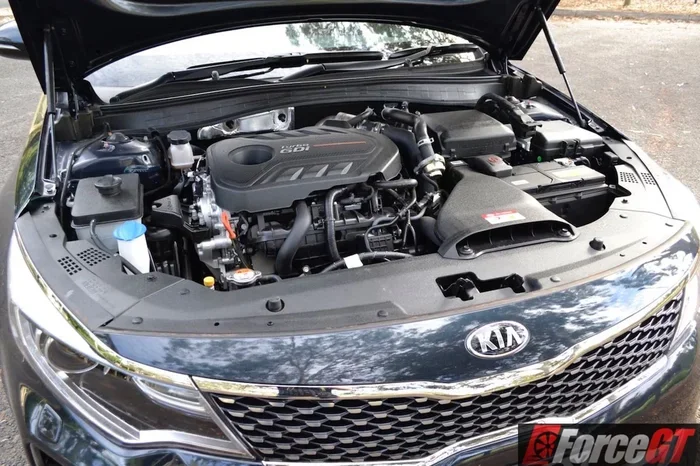
If you are not sure which engine your Optima has, check your owner’s manual or look at the engine bay. The engine size and configuration are usually printed on a label near the engine. You can also look up your vehicle identification number, or VIN, online to get the exact specs.
Where Are the O2 Sensors Located on a Kia Optima
Knowing where your O2 sensors are located helps a lot when it is time for inspection or replacement. On the Kia Optima, the sensors are positioned along the exhaust system. Let us walk through the exact locations.
Upstream Sensor (Bank 1): On the 4-cylinder Optima, the upstream sensor is located on the exhaust manifold or the exhaust pipe close to the engine. It is usually easy to access because it sits near the top of the engine bay. On the V6 model, each bank has its own upstream sensor near its respective exhaust manifold.
Downstream Sensor: The downstream sensor is located further down the exhaust pipe, right after the catalytic converter. It is harder to reach than the upstream sensor because it sits underneath the car. You may need to lift the vehicle to get proper access.
On the V6 Optima, you will have one downstream sensor for each catalytic converter bank. These sensors face the same direction as the exhaust flow and are secured with bolts or clips.
Finding the exact location can be tricky depending on the model year. If you are working on a 2013 through 2015 Optima, the sensors are in slightly different spots than a 2019 through 2020 model. Always refer to a repair manual specific to your year and trim level.
Signs That Your O2 Sensors Are Failing
O2 sensors do not last forever. Over time, they get coated in carbon deposits, oil ash, and other contaminants. When they start to fail, your car will give you several warning signs. Catching these early can save you from expensive repairs down the road.
Check Engine Light
The most common sign of a failing O2 sensor is the check engine light. When a sensor sends abnormal readings to the ECU, the computer triggers this warning light. You can get a diagnostic scan tool to read the specific error code. Codes between P0130 and P0167 usually point to O2 sensor problems.
Poor Fuel Economy
A bad O2 sensor can cause your engine to burn more fuel than it needs. If you notice you are visiting the gas station more often, a failing sensor could be the culprit. Some drivers report a drop in fuel economy of 20 to 40 percent when an O2 sensor goes bad.
Rough Idle or Stalling
When the ECU gets incorrect oxygen data, it cannot balance the fuel-air mixture properly. This can cause your engine to idle roughly, hesitate during acceleration, or stall at stoplights. These symptoms often get worse as the sensor continues to degrade.
Failed Emissions Test
Since O2 sensors directly control emissions, a failing sensor will likely cause you to fail an emissions test. If your car has been passing tests for years and suddenly does not, check the O2 sensors first.
Rotten Egg Smell from Exhaust
A rich fuel mixture caused by a bad sensor can produce sulfur-like smells from the exhaust. This happens because unburned fuel passes through the exhaust system. If you smell something like rotten eggs coming from under your car, get the sensors checked.
O2 Sensor Replacement Cost and Process
Replacing an O2 sensor is one of the more affordable maintenance jobs on a Kia Optima. But the cost can vary depending on several factors. Let us break down what you can expect.
Cost Breakdown
A single O2 sensor typically costs between $50 and $150 for the part alone. Labor for the replacement usually runs between $50 and $150 per sensor. So for a 4-cylinder Optima with 2 sensors, you might pay $200 to $500 total. A V6 Optima with 4 sensors could cost $400 to $1,000 for all sensors combined.
If you go to a dealer, expect to pay more than an independent mechanic. Some dealers charge a diagnostic fee just to look at your car. That fee can range from $50 to $150. An independent shop or a DIY approach can save you a significant amount of money.
DIY Replacement Tips
If you are handy with tools, you can replace O2 sensors yourself. Here is what you need to know:
- Tools needed: An O2 sensor socket (usually 7/8 inch or 22mm), a ratchet, and penetrating oil.
- Preparation: Let the engine cool completely before starting. The sensors are located on hot exhaust components.
- Removal: Spray penetrating oil on the sensor bolt and let it sit for 15 minutes. This helps break through corrosion and heat buildup.
- Installation: Thread the new sensor in by hand first to avoid cross-threading. Then tighten it with the socket.
- Reset: After replacement, use an OBD-II scanner to clear the error codes. Your check engine light should turn off.
Be careful not to overtighten the new sensor. O2 sensors are sensitive and can be damaged by excessive force. If the sensor is stuck, do not force it. Seek professional help to avoid breaking the sensor or damaging the exhaust threads.
Can You Drive with a Bad O2 Sensor
You can drive short distances with a bad O2 sensor, but you should not make a habit of it. A failing sensor causes your engine to run inefficiently. Over time, this can lead to catalytic converter damage. In fact, a bad O2 sensor is one of the leading causes of premature catalytic converter failure. And replacing a catalytic converter costs $1,000 or more, which is much more expensive than an O2 sensor.
If you are wondering whether you can drive your car with a failed component, the same principle applies here as it does with other parts. For instance, you can drive a short distance without a catalytic converter, but you should not keep doing it. Similarly, a bad O2 sensor should be replaced as soon as possible.
How to Make Your O2 Sensors Last Longer
O2 sensors typically last between 60,000 and 100,000 miles. But with proper care, you can extend their lifespan. Here are some tips to keep your sensors working well for as long as possible.
- Use quality fuel: Cheap gasoline contains more contaminants that coat O2 sensors. Try to fill up at reputable stations.
- Fix oil leaks promptly: Oil smoke and residue can contaminate the sensors. Address any engine oil leaks right away.
- Keep up with oil changes: Regular oil changes reduce the amount of carbon buildup in your engine and exhaust system.
- Avoid short trips when possible: Short trips do not allow the exhaust system to reach full operating temperature. This can cause moisture buildup that damages sensors.
- Address engine problems early: Coolant leaks, rich fuel mixtures, and misfires all put extra stress on O2 sensors.
Some people wonder if O2 sensor cleaners actually work. The truth is that most cleaners only provide a temporary fix. If a sensor is truly failing, replacement is the best solution. Cleaning might buy you a few weeks, but it will not restore the sensor to factory condition.
Common Mistakes People Make with O2 Sensors
There are several mistakes car owners make when dealing with O2 sensors. Avoiding these can save you time and money.
Replacing sensors without a diagnosis: A check engine light does not always mean a bad O2 sensor. Many other issues trigger the same light. Always get a proper diagnostic scan before replacing parts.
Buying the wrong sensor: Not all O2 sensors are the same. Make sure you get the correct sensor for your specific Optima model and engine type. Check your VIN when ordering parts.
Ignoring downstream sensors: People often focus only on upstream sensors and forget about the downstream ones. Both are equally important for proper engine function and emissions control.
Using non-OEM or cheap sensors: Budget sensors may seem like a good deal, but they often fail within a few months. Spending a little more on a quality sensor pays off in the long run.
Delaying replacement: Some drivers ignore the warning signs and keep driving with a bad sensor. This almost always leads to more expensive repairs, especially catalytic converter damage.
When to See a Professional
While O2 sensor replacement is a manageable DIY job for many people, there are times when you should see a professional. If the sensors are rusted or stuck in the exhaust manifold, a mechanic has the tools and experience to remove them safely. If you are not comfortable working under your car, that is perfectly okay too.
A professional diagnostic can also reveal whether your O2 sensor problem is caused by something else. Sometimes a bad sensor is a symptom of a larger issue like a vacuum leak, fuel injector problem, or engine misfire. A trained technician can identify the root cause and fix it properly.
If you take your Optima to a dealer for diagnostics, keep in mind that dealers do charge a diagnostic fee. That fee covers the time and equipment needed to read your car’s error codes and run tests. It is a worthwhile investment if it helps you avoid replacing the wrong part.
Final Thoughts
So, how many O2 sensors does a Kia Optima have? The answer is 2 for the 4-cylinder models and 4 for the V6 models. These small but mighty sensors are essential for keeping your engine running efficiently, your fuel economy high, and your emissions in check.
Taking care of your O2 sensors is one of the simplest things you can do for your car. Pay attention to warning signs like the check engine light, poor fuel economy, or rough idling. Address these issues quickly and your Optima will reward you with years of reliable performance.
Whether you replace the sensors yourself or have a professional do it, the most important thing is to act fast when you notice a problem. A small investment in a new O2 sensor today can save you thousands in repair costs tomorrow. Keep your Kia Optima running its best by giving it the attention those O2 sensors deserve.
Frequently Asked Questions
Can I drive my Kia Optima with a bad O2 sensor?
Yes, you can drive short distances with a bad O2 sensor. However, prolonged driving with a failed sensor can damage your catalytic converter and reduce fuel economy significantly. It is best to replace the sensor as soon as you notice symptoms.
How often should O2 sensors be replaced on a Kia Optima?
O2 sensors typically last between 60,000 and 100,000 miles. However, they can fail earlier if you use low-quality fuel or have existing engine problems. Regular maintenance helps extend their lifespan.
What happens if I don’t replace a failing O2 sensor?
Ignoring a failing O2 sensor leads to poor fuel economy, rough idling, failed emissions tests, and potential catalytic converter damage. The longer you wait, the more expensive the repairs become.
Can a bad O2 sensor cause my car to stall?
Yes, a bad O2 sensor can cause stalling. When the sensor sends incorrect data to the ECU, the engine does not get the right fuel-air mixture. This can cause hesitation, rough idle, and stalling, especially at stoplights.
Are all O2 sensors the same price?
No, O2 sensor prices vary based on the brand, type, and location. Upstream sensors are generally less expensive than downstream sensors. OEM sensors cost more than aftermarket options but tend to last longer.
Do I need to reset my car after replacing O2 sensors?
Yes, you should use an OBD-II scanner to reset the error codes after replacing O2 sensors. This clears the check engine light and allows the ECU to recalibrate with the new sensor data.