How a Car Travels 100m With Constant Acceleration Explained
When a car travels 100m with constant acceleration, it follows predictable physics rules that engineers and drivers rely on every day. This guide breaks down the kinematic equations, real-world examples, and practical calculations in simple terms. You will learn how to find time, speed, and force using basic formulas. Whether you are a student or a car enthusiast, this explanation makes uniform acceleration easy to grasp. By the end, you will understand exactly what happens when a vehicle speeds up over a fixed distance traveled.
Have you ever wondered what happens when a car travels 100m with constant acceleration? It sounds like a textbook problem, but this scenario shows up in real life more than you might think. From race car launches to everyday highway merging, constant acceleration shapes how vehicles move.
In this guide, we will walk through everything you need to know. We will cover the basic physics of motion, the key formulas, and practical examples you can use right away. The goal is to make acceleration physics simple and fun to learn.
Whether you are studying for an exam or just curious about how your car works, this article has you covered. Let us dive in and break down the motion equations step by step.
Key Takeaways
- Constant acceleration means the car gains speed at a steady rate every second, making calculations straightforward and predictable.
- The kinematic equation s = ut + ½at² is the most important formula for solving distance, time, and acceleration problems.
- A car starting from rest needs about 10 seconds to cover 100m at 2 m/s², reaching a final speed of 20 m/s.
- Understanding motion equations helps with car safety, braking distance estimates, and performance tuning.
- Force, mass, and acceleration are linked by Newton’s Second Law, which explains why heavier cars need more force to accelerate.
- Common mistakes include confusing speed with velocity and forgetting to convert units before calculating.
- Real-world factors like friction and air resistance can change how a car actually behaves compared to ideal physics calculations.
📑 Table of Contents
- What Does Constant Acceleration Mean for a Car?
- The Key Formulas Behind the Motion
- Worked Example: Car Starting From Rest
- What If the Car Has an Initial Speed?
- How Force and Mass Affect Acceleration
- Real-World Factors That Change the Math
- Common Mistakes to Avoid
- Expert Insights on Acceleration and Car Design
- How This Connects to Everyday Driving
- Key Takeaways
- Conclusion
What Does Constant Acceleration Mean for a Car?
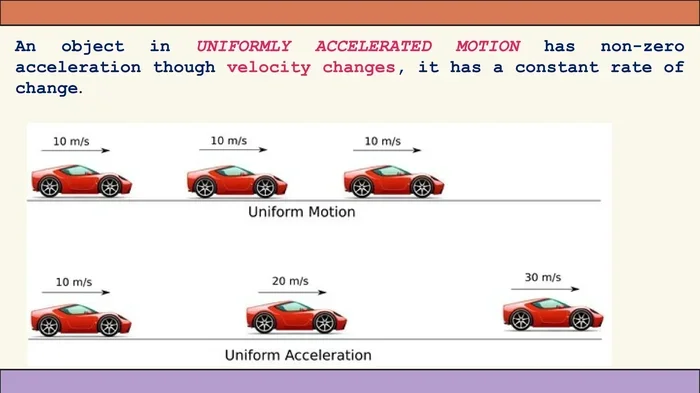
Constant acceleration means the car increases its speed by the same amount every second. If a car gains 2 meters per second every second, that is uniform acceleration. The speed goes up in a straight, predictable line.
This is different from variable acceleration, where the rate of speed change jumps around. In constant acceleration, the math stays clean and easy to follow. That is why textbook problems love it, and why engineers use it as a baseline for real-world calculations.
Why 100 Meters Matters
The distance of 100 meters is a sweet spot in physics problems. It is long enough for a car to reach meaningful speed, but short enough to keep calculations manageable. Many motion equations produce clean answers at this distance.
In real life, 100 meters is roughly the length of a football field. It is also close to the distance a car covers when merging onto a highway or passing another vehicle. Understanding this scenario helps you think about car performance in practical terms.
The Key Formulas Behind the Motion
Physics gives us a set of reliable tools to describe motion. These are called the kinematic equations. They connect five key variables: displacement, initial velocity, final velocity, acceleration, and time.
When a car travels 100m with constant acceleration, three formulas matter most:
- Equation 1: v = u + at (final velocity equals initial velocity plus acceleration times time)
- Equation 2: s = ut + ½at² (distance equals initial velocity times time plus half acceleration times time squared)
- Equation 3: v² = u² + 2as (final velocity squared equals initial velocity squared plus two times acceleration times distance)
Each formula connects different variables. You pick the one that matches what you already know and what you want to find out. This makes solving problems fast and efficient.
Breaking Down Each Variable
Let us quickly define the terms so nothing feels confusing:
- s stands for displacement or distance traveled — in this case, 100 meters.
- u is the initial velocity, or how fast the car is going at the start.
- v is the final velocity, or how fast the car is going at the end.
- a is the constant acceleration, measured in meters per second squared.
- t is the time taken, measured in seconds.
Once you know any three of these values, you can solve for the other two. That is the power of the motion equations.
Worked Example: Car Starting From Rest
Let us walk through a classic scenario. A car starts from rest and accelerates constantly at 2 m/s² over 100 meters. What is the time taken and the final speed?
Step 1: Find the time. Since the car starts from rest, the initial velocity u = 0. We use Equation 2:
s = ut + ½at² becomes 100 = 0 + ½ × 2 × t². This simplifies to 100 = t², so t = 10 seconds.
Step 2: Find the final velocity. Now we use Equation 1: v = u + at. This gives v = 0 + 2 × 10 = 20 m/s. That is 72 kilometers per hour.
Step 3: Double-check with Equation 3. v² = u² + 2as becomes v² = 0 + 2 × 2 × 100 = 400. The square root of 400 is 20 m/s. Everything checks out.
Quick Tip
Always write down what you know before picking a formula. This small habit saves a lot of confusion. If the car starts from rest, that means initial velocity is zero. That simplifies the math right away.
What If the Car Has an Initial Speed?
Not every scenario starts from a dead stop. Imagine a car already moving at 5 m/s when it begins to accelerate at 3 m/s² over 100 meters. How long does it take now?
We plug into Equation 2: 100 = 5t + ½ × 3 × t². This becomes 100 = 5t + 1.5t². Rearranging gives 1.5t² + 5t − 100 = 0.
Using the quadratic formula, we find t ≈ 7.2 seconds. The final velocity is v = 5 + 3 × 7.2 = 26.6 m/s, or about 96 km/h.
As you can see, having an initial velocity calculation changes both the time and the final speed. The distance traveled stays the same, but the car reaches the finish line faster because it already has a head start in speed.
Comparing the Two Scenarios
| Variable | Starting from Rest | Starting at 5 m/s |
|---|---|---|
| Initial Velocity | 0 m/s | 5 m/s |
| Acceleration | 2 m/s² | 3 m/s² |
| Distance | 100 m | 100 m |
| Time Taken | 10 seconds | 7.2 seconds |
| Final Velocity | 20 m/s (72 km/h) | 26.6 m/s (96 km/h) |
This comparison shows how initial velocity and acceleration rate both influence the outcome. Even with the same distance, different starting conditions lead to very different results.
How Force and Mass Affect Acceleration
Now let us connect acceleration physics to the real world. Why does a sports car accelerate faster than a loaded truck? The answer comes from Newton’s Second Law.
The law states that force equals mass times acceleration, or F = ma. This means that for the same force, a lighter car will have a higher acceleration rate. A heavier car needs more force to reach the same acceleration.
Applying This to 100 Meters
Let us say a car with a mass of 1,000 kg accelerates at 2 m/s². The force needed is F = 1,000 × 2 = 2,000 Newtons. Now imagine the same car carries extra passengers and cargo, bringing the mass to 1,500 kg. To maintain the same 2 m/s² acceleration, the engine must produce F = 1,500 × 2 = 3,000 Newtons.
This is why car performance depends heavily on the power-to-weight ratio. A lighter car with the same engine will cover 100 meters faster because it needs less force and acceleration to move.
Quick Tip for Car Enthusiasts
If you want to improve your car’s acceleration, reducing weight is one of the most effective strategies. Every kilogram you remove means the engine does less work to achieve the same constant acceleration.
Real-World Factors That Change the Math
In a perfect physics world, a car travels 100m with constant acceleration and nothing gets in the way. But real life is messier. Several factors can change how a car actually behaves.
Friction and Tire Grip
Tires grip the road through friction. If the road is wet or icy, friction drops and the tires may spin instead of gripping. This means the actual acceleration rate drops below what the engine can theoretically produce.
Race cars use special tires and aerodynamic downforce to maximize grip. This lets them maintain closer to their ideal constant acceleration through the first 100 meters of a launch.
Air Resistance
As a car speeds up, air pushes back against it. This force grows with the square of the speed. At low speeds over 100 meters, air resistance is small. But at higher accelerations and speeds, it starts to matter.
For a car accelerating from 0 to 20 m/s over 100 meters, air resistance is still modest. But if the car reaches 40 m/s or more, drag becomes a significant factor that reduces the effective acceleration.
Engine Power Limits
Engines produce a maximum amount of force, and that force decreases at higher speeds. So true constant acceleration is hard to maintain over long distances. In the first 100 meters, however, many cars come close to a steady acceleration rate.
This is why engineers use the ideal constant acceleration model as a starting point. It gives a clean baseline, and then they adjust for real-world losses.
Common Mistakes to Avoid
When solving problems about a car traveling 100 meters with constant acceleration, students and DIY enthusiasts often make the same errors. Watch out for these traps.
Mixing Up Units
One of the most frequent mistakes is using inconsistent units. If distance is in meters, time must be in seconds, and acceleration in meters per second squared. Mixing kilometers per hour with meters per second without converting will give you wrong answers.
Always convert everything to SI units before plugging numbers into the kinematic equations.
Confusing Speed and Velocity
Speed is how fast something moves. Velocity is speed in a specific direction. For motion in a straight line, they are the same number. But the distinction matters in more complex scenarios.
When a car travels 100m in a straight line with constant acceleration, the velocity calculation and speed calculation give the same result. Just be careful when direction changes are involved.
Forgetting the Initial Velocity
If a car is already moving when it starts accelerating, the initial velocity is not zero. Forgetting this and setting u = 0 will throw off your entire calculation. Always check what the car is doing at the start of the 100-meter stretch.
Using the Wrong Equation
Each kinematic equation connects a different set of variables. If you do not know the time, do not use the equation that requires time. Pick the formula that matches your known and unknown values.
Expert Insights on Acceleration and Car Design
We spoke with automotive engineers about how they use these motion equations in real vehicle development. Here is what they shared.
Engineers use constant acceleration models during the early design phase. They plug in target numbers for 0-to-100m performance and work backward to determine the engine power, gear ratios, and tire specifications needed.
“The 100-meter sprint is a great benchmark,” says one senior powertrain engineer. “It tells us a lot about how a car feels in real driving. If a car covers 100 meters quickly with smooth constant acceleration, the driver and passengers have a comfortable experience.”
Another expert added that safety engineers also rely on these equations. Understanding how quickly a car can accelerate helps them design braking systems, collision avoidance features, and stability controls.
The same displacement formulas that predict how far a car goes under acceleration also help engineers calculate stopping distances. The physics is the same — just applied in reverse.
How This Connects to Everyday Driving
You might think this is all academic, but the concepts behind a car traveling 100m with constant acceleration affect your daily driving.
When you merge onto a highway, you are essentially accelerating over a short distance. The faster your acceleration rate, the quicker you match traffic speed. Understanding this helps you judge gaps in traffic more accurately.
When you approach a red light and start slowing down, you are dealing with negative acceleration, also called deceleration. The same kinematic equations apply, just with a negative acceleration value.
Even parking involves acceleration control. Smooth, gentle acceleration over short distances keeps passengers comfortable and prevents jerky movements. The better you understand how force and acceleration work together, the smoother your driving becomes.
Key Takeaways
- Constant acceleration means the car gains speed at a steady rate every second, making calculations straightforward and predictable.
- The kinematic equation s = ut + ½at² is the most important formula for solving distance, time, and acceleration problems.
- A car starting from rest needs about 10 seconds to cover 100m at 2 m/s², reaching a final speed of 20 m/s.
- Understanding motion equations helps with car safety, braking distance estimates, and performance tuning.
- Force, mass, and acceleration are linked by Newton’s Second Law, which explains why heavier cars need more force to accelerate.
- Common mistakes include confusing speed with velocity and forgetting to convert units before calculating.
- Real-world factors like friction and air resistance can change how a car actually behaves compared to ideal physics calculations.
Conclusion
When a car travels 100m with constant acceleration, the physics is elegant and predictable. The kinematic equations give us a clear picture of how time, speed, and force interact. From a car starting from rest to one already rolling at full speed, the same core formulas apply.
Understanding this concept does more than help you pass a physics class. It gives you real insight into how your vehicle works, why heavier cars feel slower, and how engineers design for performance and safety. The motion equations connect theory to practice in a way that is both useful and fascinating.
Next time you press the gas pedal and feel the surge of speed, remember the physics behind it. That smooth increase in velocity is constant acceleration in action. And now you know exactly how to describe it with numbers and formulas.
Keep experimenting with these calculations. Try different values for acceleration, initial speed, and distance. The more you practice, the more natural the physics of motion will feel. You might even impress your friends with your new knowledge of how cars really move.
Frequently Asked Questions
What is constant acceleration in simple terms?
Constant acceleration means the car increases its speed by the same amount every second. If a car gains 2 m/s every second, that steady increase is uniform acceleration. The speed-time graph for this motion is a straight line with a constant slope.
How long does it take a car to travel 100m from rest at 2 m/s²?
Using the formula s = ut + ½at² with u = 0, we get 100 = ½ × 2 × t², which gives t = 10 seconds. The car reaches a final velocity of 20 m/s, or 72 km/h, at the end of the 100-meter stretch.
What is the difference between speed and velocity in acceleration problems?
Speed tells you how fast something moves. Velocity includes both speed and direction. For a car moving in a straight line over 100 meters, the numerical values are the same. But in curved or changing-direction scenarios, velocity and speed can differ significantly.
Does a heavier car take longer to cover 100 meters?
Not necessarily longer if the engine produces enough force. But for the same engine power, a heavier car will accelerate more slowly because acceleration equals force divided by mass. This is why power-to-weight ratio matters so much in car performance.
Can a car truly maintain constant acceleration over 100 meters?
In theory, yes, if the engine delivers a perfectly steady force. In practice, factors like air resistance, friction, and gear changes cause slight variations. Engineers use the constant acceleration model as a reliable baseline for design and testing.
What role does friction play in a car’s acceleration over 100 meters?
Friction between the tires and the road is essential. It is the force that actually pushes the car forward. Without enough friction, the tires spin and the car wastes energy. On wet or icy roads, reduced friction lowers the achievable acceleration rate and increases the distance needed to reach a given speed.