Can a Ford F-150 Power a House When the Grid Fails
A Ford F-150 can indeed power a house during a grid failure, thanks to its built-in generator and Pro Power Onboard system. This pickup truck acts as a reliable home backup power source for essentials like lights, refrigerators, and heating systems. Understanding F-150 power output and proper setup makes all the difference. Read on to learn exactly how this works and what you need to know.
Power outages are more common than most people think. Storms, grid failures, and equipment malfunctions can leave your home in the dark for hours or even days. When that happens, you need a reliable home backup power solution fast.
Here is a question that might surprise you. Can a Ford F-150 power a house? The answer is yes. Ford engineers designed the F-150 with a built-in generator system that can keep your essential appliances running when the grid goes down. This truck is not just a workhorse. It is a mobile power station on wheels.
In this article, we will walk you through everything you need to know. From understanding F-150 power output to setting up your truck as a home generator, we have you covered. You will learn practical tips, real-world scenarios, and expert insights that make this topic easy to grasp.
Whether you live in a rural area prone to storms or just want peace of mind, this guide will help you see your Ford F-150 in a whole new light. Let us dive in.
Key Takeaways
- Dual Functionality: The Ford F-150 doubles as a mobile generator, giving you emergency power right out of the truck bed.
- Pro Power Onboard System: Modern F-150s come with a built-in power inverter that outputs up to 9.6 kW of electricity.
- Easy Setup: Connecting your F-150 to your home is simple with the right power inverter and transfer switch.
- Fuel Considerations: A full tank can run your F-150 generator for many hours, but fuel efficiency matters during extended outages.
- Not a Full Replacement: The F-150 works best for essential circuits, not powering your entire home 24/7.
- Cost-Effective: Using your existing truck saves money compared to buying a traditional standby generator.
📑 Table of Contents
How the Ford F-150 Can Power Your Home
The idea of using a truck to power a house might sound unusual. But modern Ford F-150 models come equipped with technology that makes this entirely possible. The system is built right into the truck and ready to go when you need it most.
The Built-In Generator System
Ford introduced the Pro Power Onboard system in recent F-150 models. This feature turns your truck into a truck generator that supplies clean, stable electricity. You do not need any extra equipment to start using it. Just start the engine, plug in, and power up.
The Pro Power Onboard system works like a large portable power station. It converts the truck’s mechanical energy into usable electrical energy. This means you can run tools at a job site or keep your home comfortable during an outage.
What Can You Run on an F-150?
The real question is what can you actually power. The answer depends on your truck’s model year and configuration. Here are some common household items an F-150 can handle:
- Refrigerator and freezer — keeps food safe during long outages
- Lights and fans — basic comfort and safety
- Phone and laptop chargers — stay connected
- Window air conditioner — beat the heat
- Sump pump — prevent basement flooding
- Medical devices — critical for health needs
- Television — stay informed during emergencies
You can run several of these at the same time. However, you need to be mindful of total wattage. Overloading the system will trip a breaker. We will cover wattage limits in the next section.
Quick Tips for Getting Started
- Read your F-150 owner’s manual to find the generator outlet location
- Practice connecting the system before an emergency happens
- Keep extension cords rated for outdoor use near the truck
- Store fuel stabilizer if you plan to leave the truck unused for weeks
Understanding the F-150’s Power Output
Not all F-150 models produce the same amount of electricity. The power output varies depending on the engine, trim level, and year. Let us break down what you can expect from different configurations.
Wattage Capacity by Model
The Pro Power Onboard system comes in different sizes. The most common outputs are 2.0 kW, 2.4 kW, 4.5 kW, and 9.6 kW. Higher-end models, especially the PowerBoost hybrid versions, offer the most electricity.
Here is a quick comparison of what different F-150 models can deliver:
| F-150 Model | Power Output | Best For |
|---|---|---|
| Standard Cab (Base) | 2.0 kW | Charging devices, lights |
| SuperCrew (Mid-Range) | 2.4 – 4.5 kW | Refrigerator, sump pump |
| PowerBoost Hybrid (Top) | 9.6 kW | Multiple appliances, full essentials |
The 9.6 kW output from the PowerBoost hybrid is impressive. It can handle a surprising number of household items at once. This makes it one of the most capable truck generators on the market today.
How Long Can the F-150 Run?
Runtime depends on fuel tank size and load. A standard F-150 has about 23 to 26 gallons in the tank. At moderate load, you can expect the generator to run for 12 to 24 hours on a full tank.
Of course, fuel efficiency plays a big role. If you are running heavy loads like an air conditioner, you will burn through fuel faster. Planning ahead and keeping extra fuel on hand is a smart move.
Expert Insight: Understanding Watts vs. Watts Peak
Ford lists both continuous and peak wattage for the Pro Power Onboard system. Continuous wattage is what the system can sustain indefinitely. Peak wattage is the short burst available when starting motors like refrigerators or pumps.
Always plan around continuous wattage for long-term use. This prevents tripping breakers and protects your appliances from damage.
Setting Up Your F-150 as a Home Generator
Using your F-150 to power your house requires a few simple steps. The process is straightforward, but doing it correctly ensures safety and efficiency. You do not need to be a mechanic to set this up.
Step-by-Step Connection Process
Follow these steps to connect your F-150 to your home electrical system:
- Park the truck outside your home, at least five feet from any door or window
- Start the engine and let it idle for a minute
- Locate the generator outlet on the truck bed or rear panel
- Plug in the power cord rated for your F-150’s output
- Connect to a transfer switch installed on your home’s electrical panel
- Flip the transfer switch to the generator position
- Power on your essential circuits one at a time
This setup keeps your home’s electrical system isolated from the grid. That is critical for safety. It also prevents backfeed, which can endanger utility workers.
What You Need for the Setup
Before an emergency strikes, gather these items:
- Heavy-duty extension cord rated for outdoor use and your F-150’s amperage
- Transfer switch installed by a licensed electrician
- Generator-rated circuit breakers for your essential panel
- Fuel stabilizer for long-term storage
- Carbon monoxide detector near the truck’s exhaust area
Common Mistakes to Avoid
Many people make avoidable errors when setting up their truck as a generator. Here are the most common ones:
- Skipping the transfer switch. This is dangerous and can damage your home’s wiring
- Overloading circuits. Do not plug in everything at once. Prioritize essentials
- Running the truck in an enclosed space. Carbon monoxide is deadly. Always park outside
- Ignoring fuel levels. Check the tank regularly and refill before it gets too low
- Forgetting to ground the system. Proper grounding prevents electrical hazards
Taking a few extra minutes to set up correctly can save you from costly mistakes. Safety always comes first.
Real-World Scenarios: When You Need It Most
Theoretical knowledge is helpful. But seeing how the F-150 performs in real situations gives you a clearer picture. Let us look at some common scenarios where truck generator power shines.
Scenario 1: Winter Storm Outage
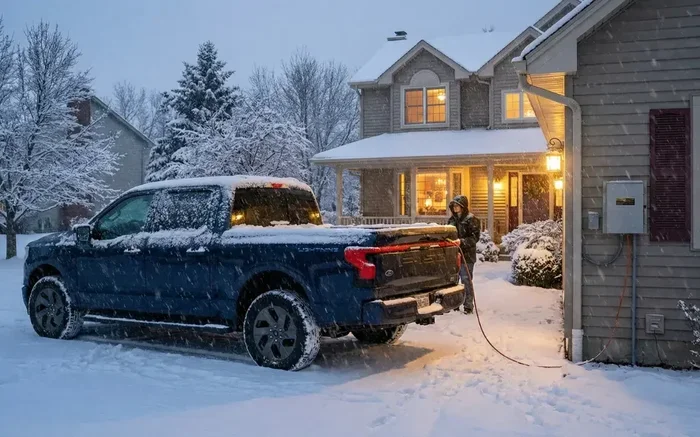
Imagine a heavy snowstorm knocks out power for 18 hours. Your furnace stops working, and temperatures drop. With an F-150 Pro Power Onboard system, you can run your furnace blower, keep the fridge cold, and charge your phone. The truck sits outside, running quietly, keeping your family warm and safe.
This is where off-grid power from a pickup truck really proves its value. You do not need to rush out to buy a noisy gas generator.
Scenario 2: Rural Power Failure
Rural homes often experience longer power outages due to downed lines and remote locations. An F-150 can serve as the primary emergency power source for days if you have extra fuel. Many rural F-150 owners swear by this setup as their first line of defense against outages.
Scenario 3: Job Site Power
The F-150’s generator is not just for home use. Contractors use it to power tools, lights, and equipment at job sites. This dual-purpose capability makes the truck even more valuable. You get work capability and home backup in one vehicle.
Expert Insight: Real-World Performance
Many F-150 owners report running their homes for 24 to 48 hours without issues. The key is managing your load wisely. Focus on the essentials first. Add non-essential items only when you have enough power to spare.
Some owners have even paired their F-150 with solar panels on the truck bed. This extends runtime significantly and reduces fuel consumption. It is a creative approach to residential power that is gaining popularity.
Pros and Cons of Using an F-150 for Home Power
Like any solution, using your Ford F-150 as a home generator has advantages and limitations. Understanding both helps you make an informed decision.
The Advantages
- Convenience. Your truck is likely already parked in the driveway. No need to buy a separate generator
- Clean power output. The Pro Power Onboard system produces clean sine wave electricity safe for sensitive electronics
- Quiet operation. Modern F-150 generators run much quieter than traditional portable generators
- Dual fuel options. Some models support dual fuel capability, giving you flexibility
- Built-in fuel tank. No need to store extra gasoline cans
- High resale value. The truck retains value even if you use the generator feature regularly
The Limitations
- Limited wattage. The F-150 cannot power your entire home at once. It works best for essential circuits
- Fuel consumption. Running the truck for extended periods uses a lot of gas
- Noise at full load. While quieter than most generators, it is still an engine running outside
- Not designed for 24/7 use. The system is meant for intermittent or short-term use
- Upfront cost. Higher trim levels with the Pro Power Onboard system cost more
Comparison Table: F-150 vs Traditional Standby Generator
Here is how the F-150 stacks up against a traditional home standby generator:
| Feature | Ford F-150 Generator | Traditional Standby Generator |
|---|---|---|
| Power Output | Up to 9.6 kW | 7 kW to 24 kW |
| Fuel Source | Gasoline or hybrid | Natural gas or propane |
| Runtime on Full Tank | 12 to 24 hours | Days with continuous fuel supply |
| Portability | Fully portable | Permanent installation |
| Noise Level | Moderate | Low to moderate |
| Setup Complexity | Simple plug-in | Professional installation required |
| Cost | Already owned (no extra purchase) | $3,000 to $15,000+ installed |
| Multi-Purpose Use | Yes (hauling, towing, commuting) | No (generator only) |
This comparison shows that the F-150 is a strong option for emergency power and short-term outages. For long-term or whole-home power, a traditional standby generator may be a better fit.
Tips for Maximizing Your F-150’s Power Potential
Want to get the most out of your F-150 as a home generator? These practical tips will help you squeeze every last watt from your truck.
Manage Your Load Smartly
Not all circuits are equal. Prioritize the ones that matter most. Start with your refrigerator, furnace blower, and phone chargers. Once those are running, add other items if you have power left over.
A simple rule of thumb. Add up the wattage of everything you want to run. Make sure the total stays well below your F-150’s continuous output. This keeps the system running smoothly and prevents tripped breakers.
Keep Your Fuel Fresh
Gasoline degrades over time. Add fuel stabilizer to your tank if you plan to store the truck for extended periods. This ensures the engine starts reliably when you need it most.
During an outage, keep an eye on your fuel gauge. Refill early rather than waiting until the last minute. Running on empty can damage the fuel pump.
Consider Solar Pairing
Some creative F-150 owners install solar panels on the truck bed or tailgate. These panels trickle-charge the truck’s battery while it is running. This reduces fuel consumption and extends runtime.
While this is not an official Ford feature, it is a popular modification among off-grid power enthusiasts. Just make sure any modifications do not void your warranty.
Maintain Your Truck Regularly
A well-maintained F-150 runs better as a generator. Keep up with oil changes, air filter replacements, and spark plug checks. A healthy engine produces more reliable power and uses fuel more efficiently.
Think of it this way. You take care of your truck so it can take care of you when the lights go out.
Quick Tips Summary
- Practice before you need to. Do a test run during good weather
- Label your extension cords. Know which cord goes where
- Keep a log of fuel usage. This helps you plan for longer outages
- Invest in a quality transfer switch. This is the most important safety component
- Share with neighbors. Your F-150 can power a neighbor’s essentials too
Conclusion
The answer to the question is clear. Can a Ford F-150 power a house? Absolutely. With the Pro Power Onboard system and proper setup, your F-150 becomes a dependable home backup power source during grid failures.
From running your refrigerator and furnace to charging your devices and keeping the lights on, this truck delivers more than just towing capability. It is a versatile residential power solution that fits right in your driveway.
Understanding your F-150’s power output, setting up a proper connection, and managing your load are the keys to success. Follow the tips in this guide, avoid common mistakes, and you will be well-prepared for the next power outage.
The grid may fail, but your home does not have to go dark. Your Ford F-150 has got you covered.
Frequently Asked Questions
Can any Ford F-150 model power a house?
Most modern F-150 models from 2021 onward come with the Pro Power Onboard system. However, power output varies by trim and engine. Check your specific model’s specifications to confirm its generator capabilities.
How long can an F-150 run as a home generator?
With a full tank of about 23 to 26 gallons, an F-150 can run for 12 to 24 hours at moderate load. Higher loads reduce runtime, so fuel management is important during extended outages.
Do I need a transfer switch to connect my F-150 to my home?
Yes, a transfer switch is essential for safety. It prevents backfeed into the grid and protects your electrical system. A licensed electrician should install it for you.
Is it expensive to use an F-150 as a generator?
Not really. Since you already own the truck, there is no additional purchase cost. The main expense is fuel, which is comparable to running a traditional portable generator.
Can I power my entire home with an F-150?
The F-150 works best for essential circuits. It cannot power an entire home continuously. However, it can handle the most important loads like refrigeration, heating, and charging devices.
What happens if the F-150 runs out of fuel during a power outage?
The generator will shut off automatically. Keep extra fuel on hand and monitor your fuel gauge regularly. Refilling before the tank gets too low prevents damage to the fuel system.